PRIFYSGOL CYMRU ABERTAWE,
UNIVERSITY OF WALES SWANSEA
.                                      

Home | Search | Maps | Graphics.


One of our volunteers celebrates the arrival of the papyrus! It is in the large blue box in the background.


Richard Parkinson with the papyrus in the Egypt Centre.

Loan of the Rhind Mathematical Papyrus from the British Museum:

The Egypt Centre is pleased to announce the loan of perhaps the most important Egyptian mathematical papyrus - The Rhind Mathematical Papyrus (BM10058) from the British Museum. The loan was made possible through the generous support of various Swansea University academic departments, but particularly the Department of Mathematics and School of Engineering. It is intended to enhance and publicize the Centre's existing innovative schools' mathematics workshops through the loan of this artefact. We also have a week of special half term mathematics activities booked for the week of the 26th of May 2006 for any interested children.

The Rhind Mathematical Papyrus was originally a roll some 513 cm long and 32 cm high, and comes from an unknown site at ancient Thebes. It was presumably found in the tomb of  its owner, probably a Theban official who lived around 1530 BC in the great city of Thebes, modern Luxor. It was acquired by the Scottish lawyer A. H. Rhind during his stay in Thebes in the 1850s (hence its name) and was purchased in two pieces by the British Museum in 1865, after his death. Some small fragments of the papyrus are also in the Brooklyn Museum.  It is now mounted in two long frames, which have the numbers EA 10057-8. It is one of the most famous of all the British Museum’s magnificent collection of Egyptian papyri and a unique document in the history of mathematics.

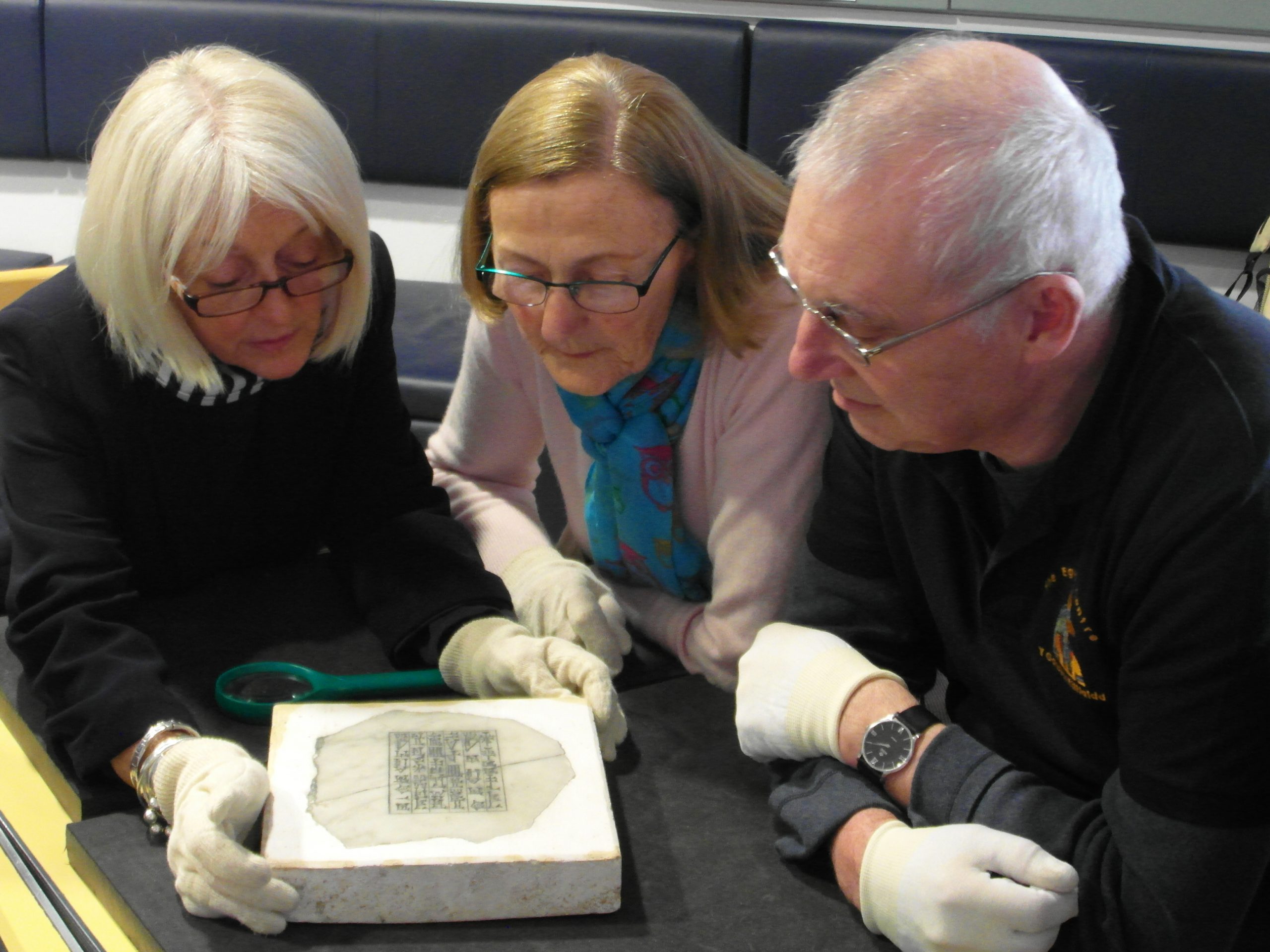
This section of papyrus on loan to the Egypt Centre consists of one third of the complete roll. It is written in hieratic in red and black ink and reads from right to left. It begins with a grandiose introduction: Accurate reckoning. The entrance into the knowledge of all existing things and all obscure secrets. This book was copied in the year 33, in the 4th month of the inundation season, under the majesty of the king of Upper and Lower Egypt, Ahmose, endowed with life, in likeness to writings of old made in the time of the king of Upper and Lower Egypt, Nimaatre. It is the scribe Ahmose who copies this writing. (Translation based on Gillings 1972, 45).

There then follows an arithmetical table, perhaps the most extensive and complete table we have from ancient Egypt. The Rhind mathematical papyrus piece in the Egypt Centre has instructions for doubling odd-numbered unit fractions with values of /3 to /87. 2000 years later the Greeks were using the same system (Gillings 1972, 47).

The Rhind Mathematical Papyrus is also important as a historical document, since the scribe Ahmose noted the date when he made his copy of the text: regnal Year 33 of the reign of Aawoserre Apophis, who is the penultimate king of the foreign Hyksos Dynasties (about 1570-1530 BC). He claims that it is copied after an original of the Twelfth Dynasty from the reign of Nimaatre Amenemhat III (about 1818-1770 BC), which may or may not be true. On the other side of the papyrus a Year 11 of an unknown king is mentioned in a series of short jottings, with a reference to the taking of some Egyptian towns. This probably refers to the battles between the Egyptians and the Hyksos before the beginning of the New Kingdom (around 1540 BC) when the foreign rulers were finally expelled.

On the 24th November 2005, the display of the Rhind Papyrus was formally launched at the Centre by Dr Richard Parkinson of the British Museum and the famous mathematician Sir Michael Atiyah. It will be on display for a year and forms part of the Centre's mathematics activities. The Centre is very grateful to the British Museum for the opportunity to borrow this piece and to the academic departments of the University who have supported this loan. 

References and further reading

Gillings, R.J. 1972. Mathematics in the time of the Pharaohs. New York: Dover Publications. 

Robins, G and Shute, C. 1987. The Rhind Mathematical Papyrus. An ancient Egyptian Text. London: British Museum Press.


Back To Events

Back to Title Page


The University | People | Life | Study | Research | Admissions.

© University of Wales Swansea. 11 November 2009. UWS Web Team.