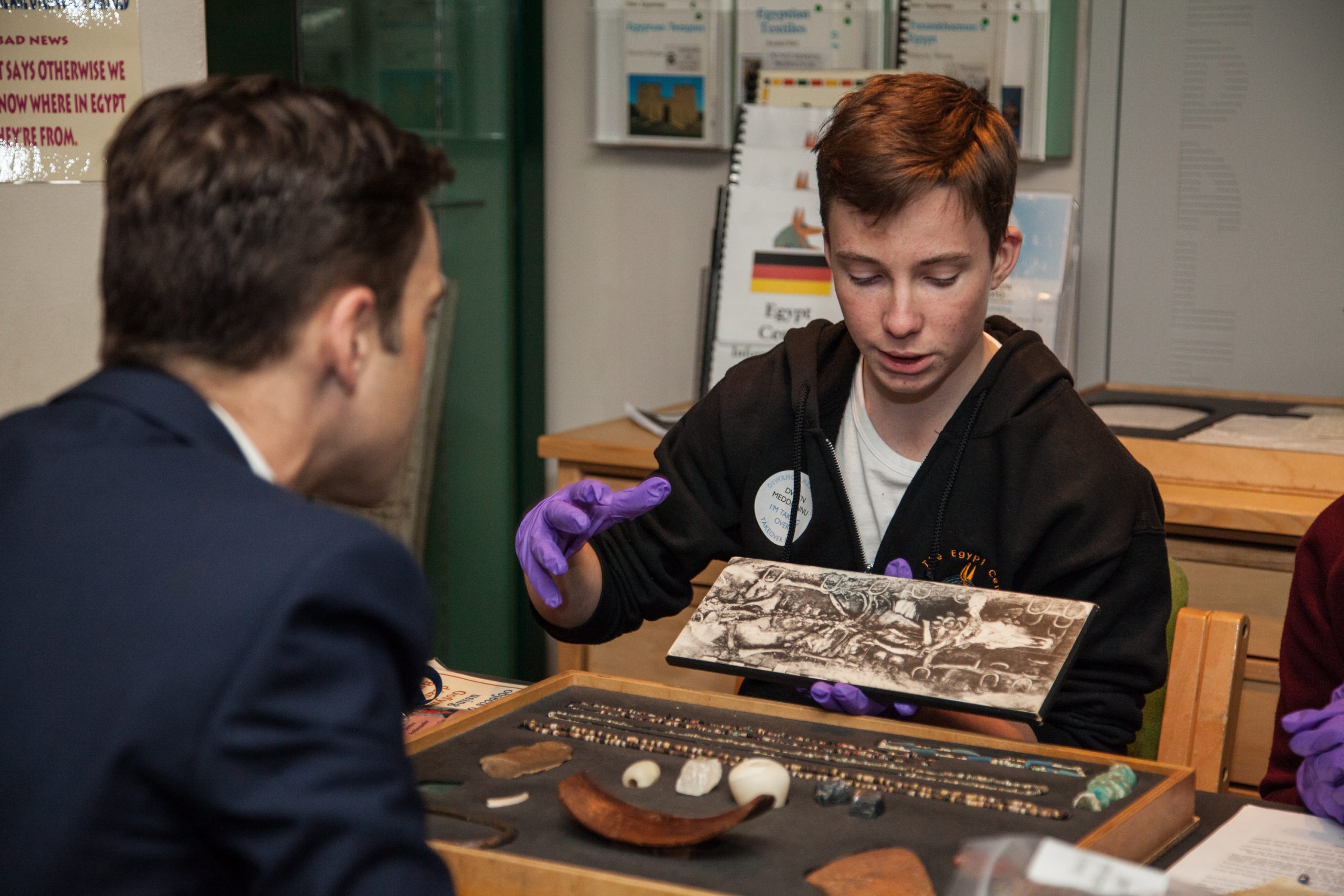
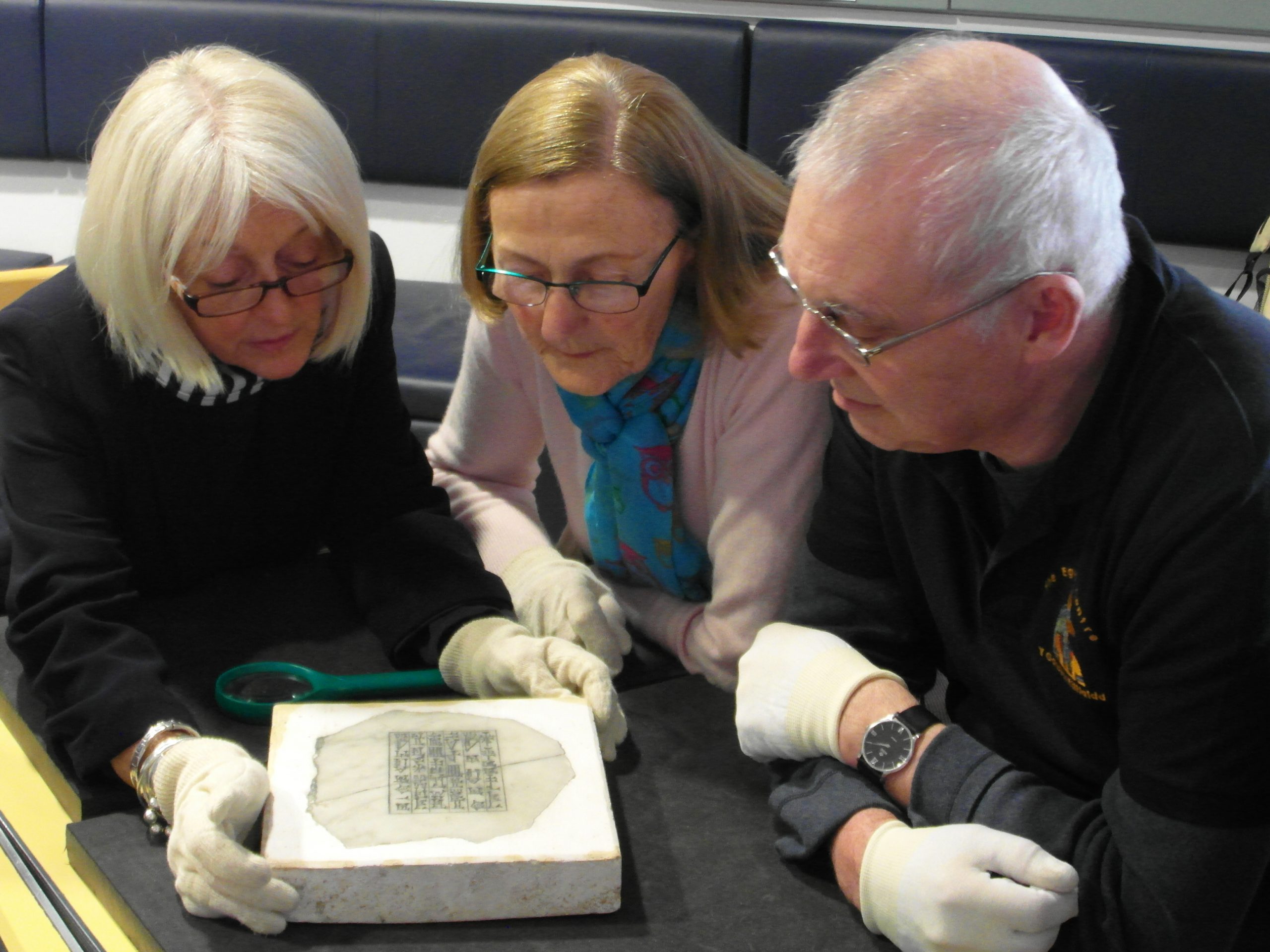
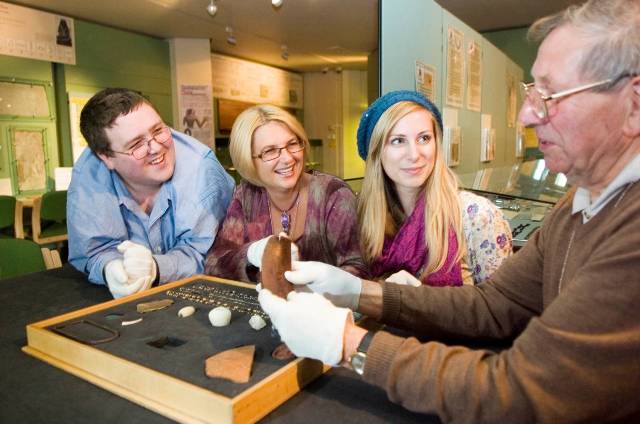
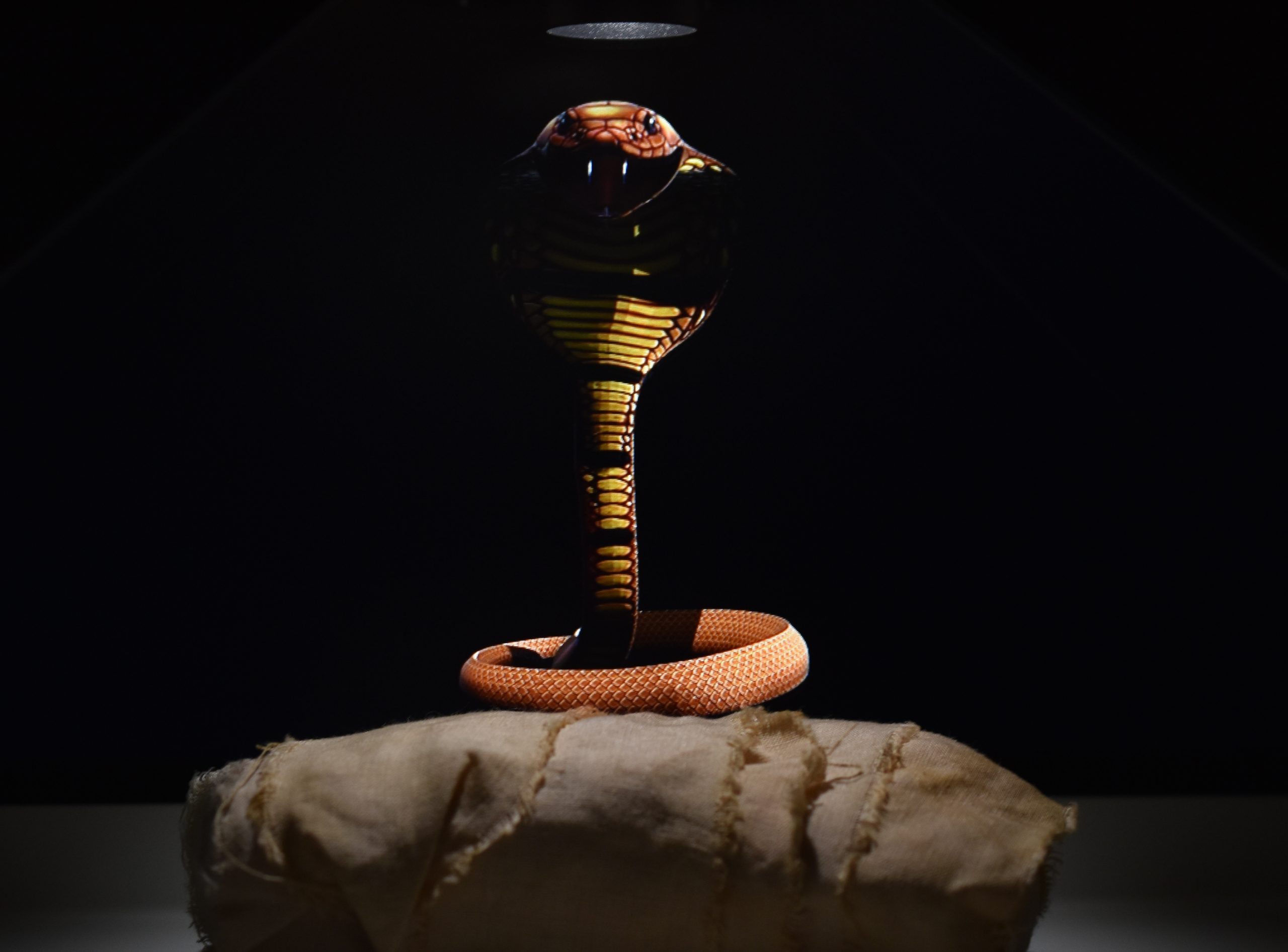
On 8th March(International Women's Day) to 28th April 2001 the Egypt Centre opened a special exhibition.

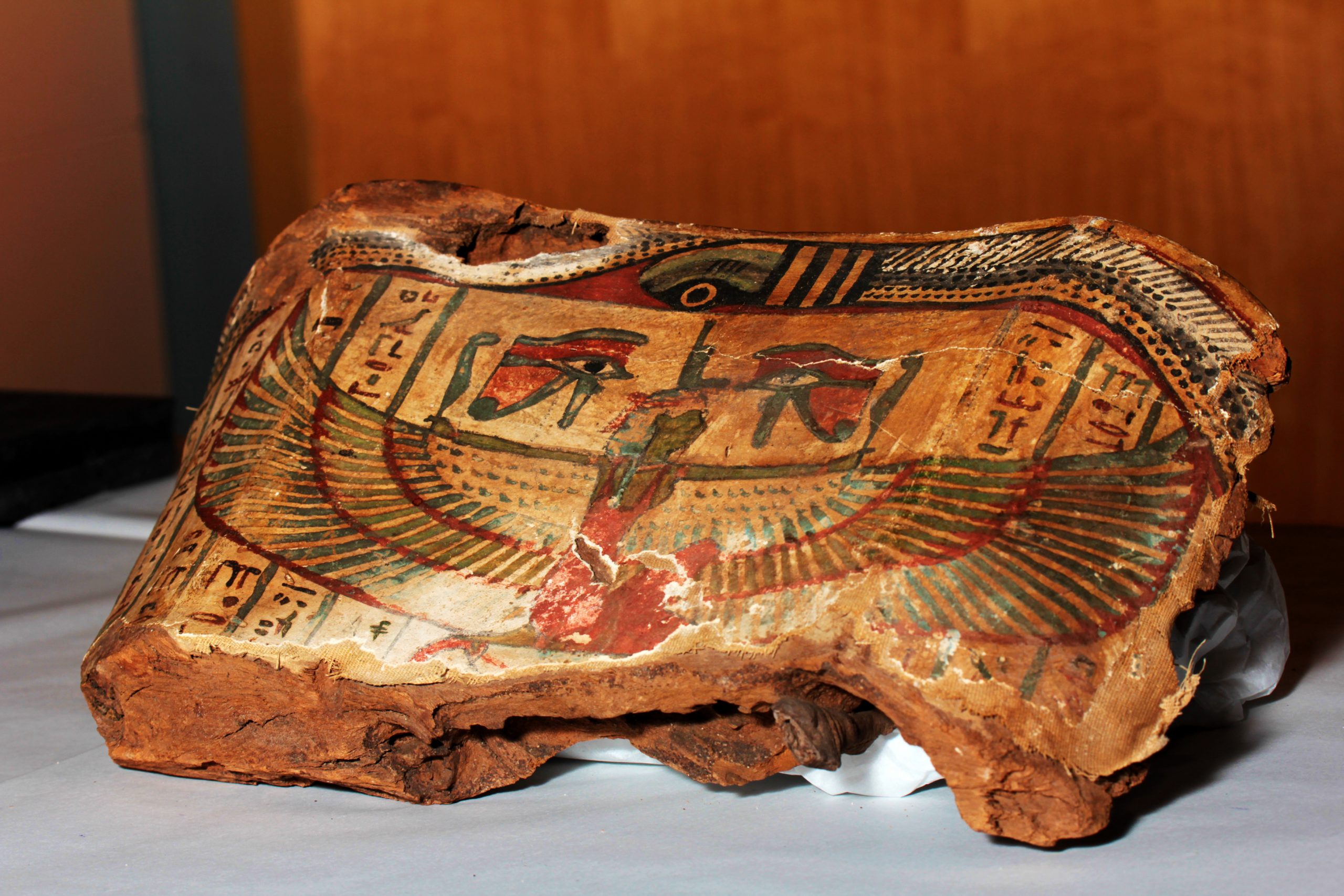
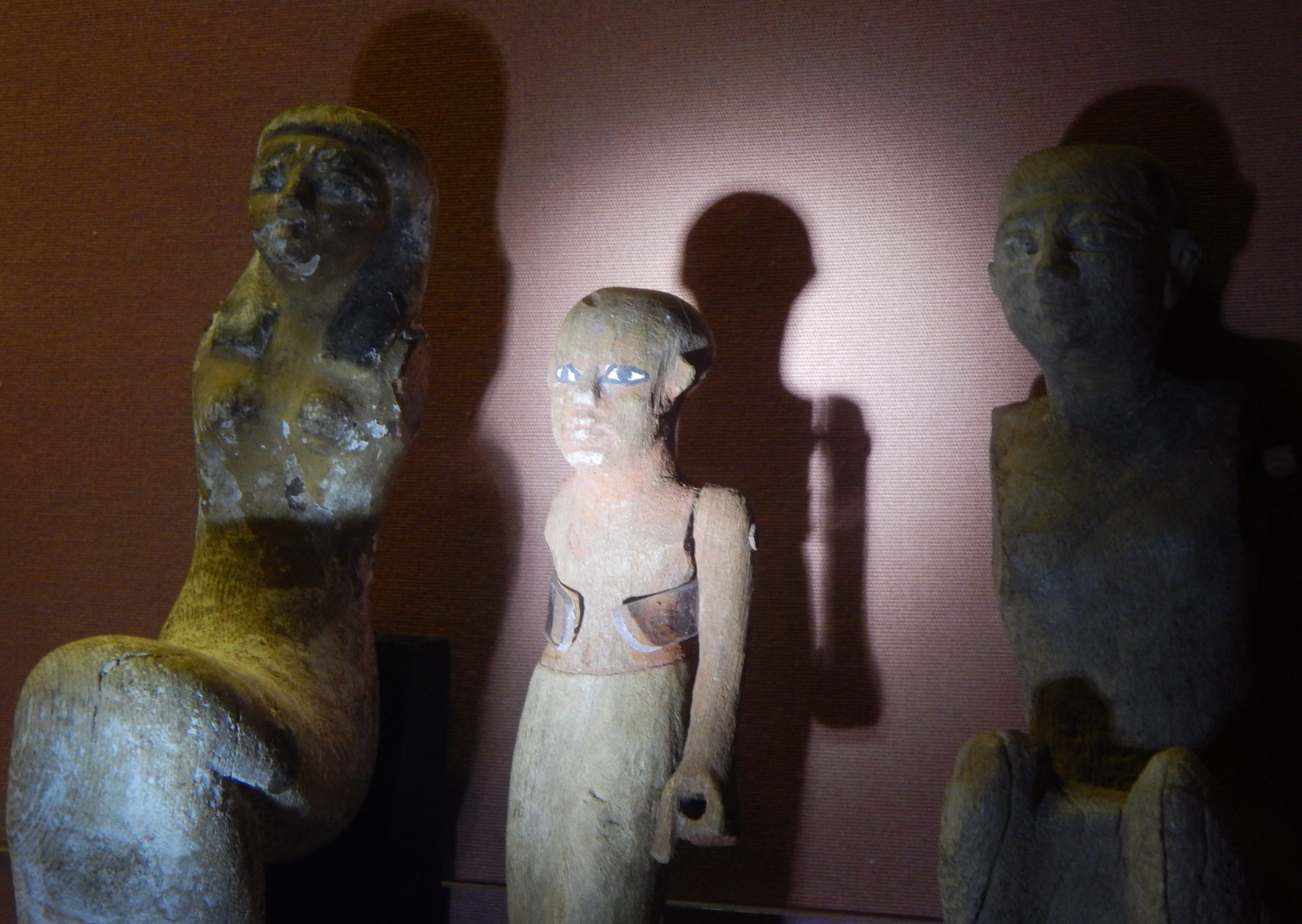
This is an exhibition of photographs and information on objects displayed in Swansea's Egypt Centre which relate to women. These include beautifully painted coffin fragments, jewellery and cosmetic items, etc. dating from 3000 BC to AD 500.

However, the exhibition is more than a display of the Centre's collection. It aims to introduce general ideas concerning gender and specifically shows how our own cultural background influences how we study the past. It shows how the past, as displayed in museums is a 'selected past'. The exhibition also aims to illustrate how the Egyptians may have viewed women. Themes which include goddesses, professions and status are explored.

The exhibition is open Tuesday to Saturday 10am to 4pm at the Centre. ADMISSION IS FREE. The exhibition is at present in the Egypt Centre but can be lent out free to any interested organisations.

A booklet has been produced in-house which futher develops the themes of the display. It is available from the Centre priced £3. Or you can download the text only below.

For futher information e-mail c.a.graves-brown@swansea.ac.uk

__________________________________________________________________

Text From Egypt Centre Trail:

Reflections Of Women In Ancient Egypt

Women, Museums and Egyptologists.

This text is based on a booklet sold in the Centre. The text does not have the pictures which are in the booklet. However, the captions have been left in.

________________________________________________________________

Contents

Introduction to the Egypt Centre

Trails

Why 'Women In Ancient Egypt' ?

Part I

Bias in presentations of the past – Can you believe what we tell you?

In death as we are in life–What can graves tell us about life?

Rich and poor

Historical evidence and dependence upon the written word

Egyptologists = men?

Themes in Egyptology–Subjects Egyptologists like to study

Gendered language

Women by women

The land that time forgot–Was Egypt really timeless?

The wives of the great and the good

Searching for the individual in the machine

Inside or outside

Obsession with status

All views are equally valid?

Inventions of the past

Does it really matter?


Part II

Women and religion – Gods, goddesses and fierce dwarves

    State religion

Hathor

Isis

Nephthys

Sekhmet

Mother of the Buchis Bull

Maat

    Religion in the Home

Horus the Child

Bes

Hathor and Isis

Women in the midst of death

Professions – Her Indoors

Women were not administrators

Women as housewives

Women in the fields

The priestess musician

Mourning

Queenship

Sexed Objects

The Little Woman – Power and Status

Fertility and sexuality

Androgyny

Neith

Ptah

Atum

Amun-Re

Sobek

The Bulti fish

The solar disk

Sexual Dualism

Conclusions – The Way Forward?

Further Reading

Bibliography

Intoduction To The Egypt Centre

The Egypt Centre is a small museum set within the University of Wales Swansea. In the entrance is a copy of the bust of Nefertiti.

The original bust of Nefertiti was found in the workshop of the sculptor Thutmose at Tell el Amarna. The role of Nefertiti in the religious life of Egypt seems to be unusual in ancient Egypt. She is often shown alongside the king officiating in religious ceremonies. Her daughters too seem to be given unusual prominence in Egyptian art of the period.

Our Nefertiti is not real in that she is a modern copy of an ancient object in another museum. The other objects in the Egypt Centre are, as far as we are aware, 'real' that is they were made in ancient Egypt some thousands of years ago. Yet do they really give us a true picture of the past?

We have two galleries and, in all, over 3000 objects, most of which are on display. Upstairs is the House of Life in which we try to present aspects of everyday life in ancient Egypt. Downstairs is the House of Death which is concerned with Egyptian attitudes to death. The division could be considered arbitrary in that death is a part of everyday life.

Trails

Artefacts can be viewed and presented in a number of ways: chronological, technological, artistic or functional aspects, for example, may be chosen for particular attention in display. Often certain objects in museums are assumed to lend themselves to particular types of display. For example, stone axes tend to be in displays with weapons. They do not have to be so. They could be put in displays about technology, chronology, power, trade, materials, colour or even gender (you might be able to think of more). Our displays in the Egypt Centre do not have one structuring approach but are a variety of presentations, often mixing objects which would never have been placed together in real life. What we have chosen to tell you about each of the objects on display is only part of what we might say. In order to show other ways of looking at artefacts in our collection we intend to present a series of 'trails'. This trail attempts to show some aspects of gender in ancient Egypt and warns against the danger of reading the present into the past. It attempts to show alternative ways of reading the past but is not intended to show any one way as being better than others.

It starts with some of the problems in trying to find out about women in ancient Egypt and goes onto some aspects of their lives. The illustrations are all numbered items from the Egypt Centre.

Why 'Women in Ancient Egypt'?

Women are just one aspect of society. Others could have been chosen, but this does not mean that the study of women is any less important than say, the study of kings, or the study of children. Women, after all, make up half the population.

Studies of women are still too frequently decried. It is said that we no longer need the feminist movement, that it is old fashioned or boring. Such responses don’t seem wholly satisfactory. Firstly, there is no single form of feminism. If you only associate the word 'feminism' with the extremist idealism of the 60s, you will be surprised to find that this trail is not a 'women as victim' presentation. Nor, on the other hand, is its purpose to present women in a particularly heroic light. Nor indeed does it argue that a feminist viewpoint is the only available option in studying the past. What it does attempt to show is that Egyptology, along with the whole of our society can benefit from a feminist perspective. Using particular objects within the Egypt Centre we can start to demonstrate this. This could be considered a 'third wave' feminist outlook (for a summary of the 'three waves' of feminism see Meskell 1999, 54-56).

As will be shown, Egyptology along with other disciplines is frequently a victim of society's own traditional and questionable belief systems.

If nothing else, feminist approaches possess a shock value which can serve as a catalyst for conciousness-raising and which can lead to both a re-evaluation of social attitudes and more perceptive academic enquiry. A study of the past lives of women challenges our deeply held assumptions about women's 'unchanging essence' and it demonstrates how the past is frequently reconstructed to fit the present. A feminist approach to artefact study makes the past more relevant to the present.

Feminist studies also lead to a re-evaluation of other apparently unrelated issues such as power and status. In fact since gender, a vital aspect of feminist studies, is so inextricably connected with other variables in social life it is difficult to see how it can be ignored.

In almost every field feminist thinking has transformed thinking, it cannot be ignored. In some other disciplines work has been done on the part played by gender in the constructing of societies. For example, work on the importance of women's weaving and cooking on Aztec state formation has been carried out by Brumfield (1991). Leacock and Nash (1981) have studied transformations in Aztec cosmology and altering configurations of male and female deities that accompany Empire growth.

Feminist approaches in archaeology seem largely to have come from processual and post-processual schools rather than culture-history (Dark 1995, 29).That is, feminism is slow to develop in disciplines which lay emphasis on empirical testing and description rather than explanation and process. This might help explain why Egyptology has been reticent in addressing feminist issues. Stacey and Thorne (1985) have also suggested that feminism has been slow to develop in positivist disciplines where it is believed only testable hypothesis are true and that all hypotheses are capable of being tested. However, this trail is not intended as a positivist, empericist, processual, neo-Darwinian or any other such discourse but rather is an attempt to show variation in ways of looking at the past.

The study of gender is relatively new in archaeology. Most books until very recently perporting to study gender issues in Egypt have been described as the 'add women and stir' variety (Wylie 1991, 34). They use a traditional historical narrative and add the few known, usually élite, women to the plot (pot). This can only be a first step, and unfortunately because of the nature of the material in the Egypt Centre, much of this trail can only seek and find the women in the the collection rather than make any new statements about them. Stirring is an easy aim if only in the sense, not intended by Wylie, that feminist viewpoints still seem to have the ability to irritate and thus arouse action!

Since 'women in Egypt' is still a new field of study, we can only glimpse as to where it might lead. Some Egyptologists – Lyn Meskell, Dominic Monserrat and Gay Robins are three examples, and there maybe others, have made great inroads into this.

On the other hand, there still seems to be a proliferation of books on Egyptology which simply re-hash old data and old methodology within a new cover (at least those in the English language – perhaps continental writers are more adventurous). This means that the non-Egyptologist, such as myself, is left with the impression that women only existed in Egypt as decorative ornaments to the great and the good.

The aim of this trail is to explore some of the 'taken-for-granted' concepts that appear in popular Egyptological literature and then look anew at items within the Egypt Centre

Bias in presentation of the past - Can you believe what we tell you?

Although the Egypt Centre covers many aspects of Egyptian society, as with all displays, it is important to be aware of bias. Bias comes both from data available (see In Death as we are in Life, etc), research objectives formulated by academics (see section on Themes in Egyptology), and the prejudice we bring from our own cultural backgrounds.

Do the objects in the Centre really represent life in Egypt?

–Most are from élite graves.

–They were selected from other available material by

excavators and grave robbers for their attractiveness

and saleability.

They range in date from 3000 BC to 500 AD.


In death as we are in life?–What can graves tell us about life?

Most Egyptological objects in any collection are from the high desert and from funerary remains. This is because fewer settlements than cemeteries have survived. Habitation sites were mainly located in cultivation areas, which are damp and are built upon level by level. Funerary remains are usually in desert areas where the dry conditions are conducive to preservation and where land, not being at such a premium means less likely hood of rebuilding upon the same plot. The fact that attractive material remains, particularly those which may be sold or displayed in museums, have been sought out by excavators in the past has meant that well over nine-tenths of excavations are those of graves. Funerary remains are important BUT, they are hardly a representative sample upon which to base conclusions about the past.

Funerary remains may be more likely to show ideals in society rather than actuality. They may also tend to be more resistant to change than activities associated with life. At Beni Hasan specialist funerary pottery is distinguished by its separate style and lack of change in type in contrast to domestic types. Funerary remains deliberately present a certain view of society and only deal with certain aspects of society. This means that we may get a skewed view of society if we only look at funerary remains.

All this means that a museum display of a past society will only reflect part of that society. Even in the Egypt Centre House Of Life, the pottery on show actually comes from graves. It may be that this type of pottery was rarely used in everyday life. We know that some pieces certainly were, from the few settlements that have been excavated, but other pieces mainly come from graves. For example the predynastic painted wares (D-ware) are rare on settlement sites.

Likewise, there is some evidence to suggest that the stone vessels on display in the House of Life were also mainly used for funerary purposes. Faience, on display in the same gallery, was used in ancient Egypt principally in the temple and the tomb.

In addition, the scenes of ordered prosperity shown on the coffins in our House of Death are perhaps more a reflection of the ideal than the actual.

How does this relate to women? The picture we see of women may not be accurate. It may be idealised. It may represent only part of the picture. Women may have been treated differently in death than in life.

Rich and poor

Most of the objects are from élite, male graves. The poor and women did not leave behind so much material. The owners of private tombs were usually men, women occur as secondary burials in these.

The Old Kingdom statues of tomb owners on display in the Egypt Centre are mainly those of men.

Stelae seem largely to have been put up by wealthier men, although the degree to which this is the case does vary from age to age. In the First Intermediate Period, for example, there are a number of stelae belonging to women. The Egypt Centre has one such example.

Historical evidence and dependence upon the written word

But in Egypt archaeology has remained stubbornly the servant of history, having been consistently regarded from the beginning as a means of providing scholars with further texts and royal monuments, and museums with specimens of material culture which illustrate the typical.

(Trigger, B.G., B.J. Kemp, D. O'Connor, and A.B. Lloyd 1983. 'Ancient Egypt a Social History' p.xii.)

The written evidence for ancient Egypt cannot be ignored and is invaluable in reconstructing the society. However, it often seems that the written word is seen as the only evidence for Egyptian history. This is perhaps partly an accident of the history of the discipline itself and part a sort of self-perpetuating snowball effect. Many Egyptologists have a background in classics and are therefore naturally interested in the written word. In addition, and as a result, much has now been written on ancient Egyptian literature. This means that students wishing to choose a subject of study may in some ways find it easier to look at inscriptions. Therefore, even more is written on the topic.

The over dependence on the written word in Egyptology has been noticed by Egyptologists themselves. For example, Barry Kemp has stated that reliance on inscriptions cannot do justice to Egyptian History (Kemp, 1997). Even those who have made a name in literature have realised its limitations. Sir Alan Gardiner, one of the great authorities of Egyptian history, stated clearly his interest in historical evidence but also its limitations in studying the past. 'What is proudly advertised as Egyptian history is merely a collection of rags and tatters' (Gardiner 1961, 53).

Concentration on literature at the expense of uninscribed archaeological evidence may exclude fields which shed light on women's histories. This is because women were not part of the scribal elite and because the written word was usually highly formulaic and idealised and not about actual events. In addition the 'focus on texts, pictures and architecture has led to a concentration on philology, art history and, to a certain extent, political history' (Andrén 1998, 41). (Popular Egyptological 'themes' are discussed below).

The historical information we have about ancient Egypt, the information the Egyptians wrote about themselves, is biased because it is written by a small group of people and because it was generally intended to present an ideal rather than realistic image.

The Egyptian evidence was written by male élites. It has been estimated that only one per cent of people in ancient Egypt could read and write (there are various estimates but this is the most commonly cited one). Very few of these were women. Women were not formally taught in scribe schools, although possibly rich girls were taught at home. Most, though not all, objects in the Egypt Centre with inscriptions are related to males. Only men are ever shown in the pose of a scribe.

There are few intimate letters or diaries to show us what people really thought. Instead the writer was all too aware of writing for an audience. Perhaps only such evidence as court cases, or perhaps letters to the dead, really show an un-selfconscious depiction of life.

In Egyptology, archaeology is often measured against historical evidence. For example, the Hyksos are known from history, so we look for them in archaeology. Archaeological questions may be different from historical ones. Archaeologists, for example might want to know about the trauma, caused by grinding corn which would show on the skeletons of the deceased. This would probably not appear in the historical record.

This dependence upon the written word has greatly straightjacketed the discipline. Literature does have an important part to play but so does archaeology. Egyptology is however increasingly breaking free of its literature-bound tradition, and the wealth of potential archaeological data is providing new insights on the past. Archaeology can ask and answer its own questions and can and does stand alongside history (some archaeologists would argue that history is only a sub-set of archaeology and so to study only history is to miss so much evidence).

Although archaeology has limitations, if properly studied, most aspects of daily life may be found. Social difference may be shown in a more concrete way whereas they may be smoothed over in textual accounts (see Andrén 1998 for the relationships between text and archaeology). Much archaeological evidence may be described as 'unconscious' in that the people who left their traces behind did not always do it with the sense that it would be 'read' in the future (of course this is not the case for the monuments of the great left behind for their forebears, these were built with a clear message). However, unconscious evidence can be seen more clearly in the settlement remains of the majority of the people. Their settlement evidence may have been concious in that it deliberately sought to convey messages to contemporaries but it was not so much a deliberate message for the future.


Egyptologists = men?

Most, although not all, well-known Egyptologists are male. However, this may be changing (B Lesko pers.com. has pointed out that in America the situation is different). A quick look at newspaper from the predecessor of The Egypt Centre reveal that although the first curator was a woman (Dr Kate Bosse Griffiths) the press photographers photographed and interviewed men about the museum. Most are white and middle class. A high percentage are western. They are certainly not 'normal' people! The same applies to the museum curators of the larger museums and 'successful' archaeologists. There are many reasons for this and it would be unfair to blame the Egyptologists, museum curators or archaeologists themselves for being an unrepresentative sample of the population. The fact remains, however, that they are atypical. Sometimes it is a good idea for an atypical group to study a typical group. New insights may be gained on the study group. Yet, if the research group is always composed of a minority atypical group, does that not reinforce bias?

Of course, it is not the case that only men are biased towards gender assumptions and stereotypes. From personal experience, I know that female museum curators are used to getting letters addressed to ‘Dear Sir’ and that that there is an assumption that males in an institution are the senior members of staff. This tendency to assume that all curators are male seems more marked among male visitors but is not exclusive to them. If such assumptions are made by our own society it would be unsurprising if we did not make similar assumptions upon the past. Egyptology is not immune from this.

Themes in Egyptology – Subjects Egyptologists like to study.

Obsession with dynasties, the powerful, the technological and with warfare might be seen by some as a reflection of Egyptology's male based methodology (this could also be a criticism levelled at other disciplines). On the other hand, perhaps this view is based on the unfounded assumption that women are not interested in war machines and the minutiae of the family history of the powerful. Interest in the rich and powerful may be a result of concentration upon literature, thus the Egyptologist is led to taking an interest in those subjects which the ancient Egyptians thought were important about themselves. What do you think? It probably doesn't matter if men’s interests are not the same as those of women, but what does matter is if women's interests are not considered 'serious'.

The idea that textiles are not usually considered a suitable, i.e. male, subject for study in Egyptology is discussed under the section of Fertility and Sexuality. Basketry also seems to be a subject that has received little interest. Despite the fact that many thousands of basketry items survive in Egyptian graves, the Egypt Centre has not one example. Perhaps you could guess why this might be.

Gendered language

Archaeological and Egyptological books are still being written in a language which could be described as sexist, for example the use of terms such as 'man' instead of person or human. Much work has been done on how gendered language influences how we look at our own and other societies.

Some feminists would even state that whole scientific methodology is so male based that we even need to start writing in a different style. The use of the passive voice, the cult of certain 'authorities', blind use of statistics, single-cause explanations, the so called 'objective interpretation,' etc., over use of footnotes and exhaustive/exhausting bibliographies, have all been cited as a result of male dominated academic studies. [write like a scientist, write like a man?]. Modern archaeology reports often give a false picture in that they do not allow for uncertainty and unsolved problems and the individual is always absent (Hodder 1995, 263-274). Please look at the labels in the Egypt Centre and our information sheets and let us know if you feel this to be the case. This trail has consciously used certain 'authorities' to back up the author's views in order to lend weight to arguments. The bibliography was included to prove that other people thought the same as the author. Is this justified, or sad?

Women by women

So, if historical sources are the evidence of men, largely interpreted by men, perhaps studies by women might be more satisfactory. Despite a slow start, studies that focus upon women now seem to be more in vogue in Egyptology. Many of the publications are written by women, but this does not make them immune from bias.

Joyce Tyldesley (1994) and Barbara Watterson (1991) take women as a uniform category and describe their lives according to Western concepts: economics, law, love, marriage, dress, etc. This says more about our own attitudes to women than Egyptian attitudes. Sources are decontextualized so that Cleopatra and Hatshepsut may be discussed in the same section. Hatshepsut reigned from 1473 to 1448 BC and Cleopatra from 51 to 30 BC. In time scale, this would be like comparing the society in which the iron-age queen Boudicca lived with that of Mary Tudor.


The land that time forgot?–Was Egypt really timeless?

The idea of a timeless Egypt is perhaps over emphasised. Are we blinded by the abundance of state art, and the great 'achievements' of architecture, the massive piles of 'mankind'? Egyptian 'art' and literature aimed to perpetuate the myth of a timeless society. But beneath this gilded, unmoving façade, we might glimpse geographical and diachronic differences.

Certainly many objects have a geographical bias. For example paddle dolls such as that in the House of Life (Fig. 62) are largely found in Upper Egypt. Geographical variation is frequently underplayed in Egyptological histories with a few exceptions, for example the work of Herman Kees.

Diachronic difference too are often underplayed in Egyptological literature. Women’s roles, throughout the 4000 years of Egyptian history, are often shown as static. Yet there is evidence to support the idea that there were more women involved in temple rituals in the Old Kingdom than in later periods. Also they held more administrative titles and were more able to participate in business transactions in the Old Kingdom than in later periods. In state formation it has been suggested that women’s power is frequently undercut (Silverblatt 1988). Perhaps this is what we witness in the changing status of Egyptian women?

For the Graeco-Roman period the Greek historian Herodotus is often quoted: 'The Egyptians in their manners and customs, seem to have reversed the ordinary practices of mankind. For instance, women attend market and are employed in trade, while men stay at home and do the weaving' (Herodutus Histories, Book II, 35). This statement is frequently quoted in articles about women in ancient Egypt. Firstly, is true that in Hellenised Egypt there was no purdah for Egyptian women and, even though in larger houses there were women's quarters, they were not expected to remain therein. However, we should realise that this was only one period of Egyptian history and one which may have been quite different to earlier periods. Secondly, much work has been done to illustrate that Herodotus was naturally influenced by his own cultural background where women were restricted in cultural life.

The perception of Egypt's great achievements, and its seeming timelessness, are partly due to the monumentality of its material culture. The fact that pyramids are still standing inspires awe and suggests that Egypt was always the land of the pyramid. This monumentality is not only misleading in suggesting an unchanging never-never-land but focuses our minds on kings and great men, the minority.

Timelessness may also be a result of the funerary nature of most Egyptological evidence. Funerary and religious aspects of society are often much slower to change than other aspects.

The illusion of timelessness is also due to the reuse and copying of the styles and art of earlier monuments by later kings in order to legitimise their rights. Egyptian kings, like many other rulers, used family histories to trace lines of descent and each king was not so much an individual but a born-again Horus. As Gardiner has stated, the Egyptian reverence for 'the time of the ancestors' could lead to downright falsification.

In the Old Kingdom at least, the perpetual cycle seems to be more a feature of the king than his people. It is not until the Middle Kingdom that non-royals also present themselves in death as Osiris, although whether they also saw their offspring as themselves reborn is debatable. So timelessness may be more a feature of kingship and the state than of the individual. By looking at non-royals we may see more evidence of change.


The wives of the great and the good

The concentration on the 'great and the good', which is also exactly what Egyptian scribes almost formally present to us, has perhaps led to a false sense of security in Egyptology. Knowing the lists of the major kings, does not mean that we really know Egypt. Are the names of individual kings and their queens really all that important in understanding the structuring of society?

Back to women. Many of the studies of women in Egypt are of the 'powerful women in Ancient Egypt' variety, that is, they do not deal with the role of women in general, but only with a small selection of society. Studies of female rulers are perhaps driven by admiration. Joyce Tyldesley writes of an Egyptian queen in the first paragraph of one of her books, Hatchepsut : 'Queen or, as she would prefer to be remembered, King Hatchepsut ruled 18th Dynasty Egypt for over twenty years. Her story is that of a remarkable woman....' There is not necessarily anything wrong with such studies, but we should be aware that they may not show the whole story.

Searching for the individual in the machine

Historically, archaeology has tended to look for the typical rather than the exceptional. More recently the idea of 'queer theory' has been given more prominence. In Egyptology, the wealth of material evidence should make the search for the individual easier, but there are problems.

In studying the élite we may miss the individual, or at least the 'average' individual. We do have extensive studies of the lives of individual kings and their courtiers. However, in looking at the evidence surrounding them are we seeing individuals or presentations of superstars by the ancient Egyptian 'media'? In the case of burial, for example, for the élite this was a highly visible, public display for the community. With the poorer, it was perhaps a more small scale individual affair, as has been demonstrated for Deir el-Medina by Lynn Meskell (1997). Gardiner too has pointed out that the narratives of the 'lesser' are more illuminating than those of the sovereign (1961, 57).

Individualism may also be hidden in museum displays which attempt to show typical examples rather than unusual types. This is accentuated by the tendency to assume that the atypical is fake.

How does this relate to women? Some feminist writers have seen women as an unchanging monolithic group. Men have been seen in this way too. Such essentialist views ignore differences of race, class, religion, etc. or consider them secondary to the structuring influence of gender. If we search for the individual we can perhaps attempt to reintroduce factors other than gender.

Inside or outside

Any study of the past must decide whether to use an emic or etic viewpoint, or both. Do we use the Egyptian King lists to divide up the past in the way the Egyptians did, or should we use our own cultural markers? Bickerman, in Chronology of the Ancient World, (1968), names queens alongside kings whenever they had more power, starting with Cleopatra III. However, later historians ignored the powerful queens. Burnstein (1985) is the first contemporary historian to revise king lists to take such women into account in a book that does not deal exclusively with women. Burnstein names queens before kings in his 'King Lists' where it is clear that she wielded political power.

Establishing the status of women in Ancient Egypt seems to be a current obsession, perhaps rightly so since so much of understanding societies depends on understanding who has 'status'. This introduces further problems. Firstly, what is status? Status is such a relative term. Different social groups may recognise status in different ways. Quite how one can judge whether women saw themselves as of low status, without hearing their words, it is difficult to know.

One definition of lower status might be that although one partakes in production, one is not allowed to partake in decisions regarding that produce. However, this might deny status of individuals within a study group. Certain women might be involved in production, other female individuals might partake in decisions regarding produce. If decision making is a mark of status, what then is the status of the British Queen today? In addition, what is production? A woman might have control of childrearing which one could argue is the most important form of production and yet be considered of low status. Some labour may be more valued simply because it is performed by men. The undervaluing of women's work is often regarded as a result of, or a necessary precursor to state formation (Silverblatt 1988).

All views are equally valid?

Views towards women alter as society alters, so much so that some archaeologists take the extreme relativist view that there can be no one view of the past but that all views are as valuable as others. What do you think?

Inventions of the past

So we invent the past to suit ourselves. This can lead to extremes. Father-daughter marriages seem to have been relatively common in Egyptian royal families. Modern scholars sometimes seek to deny this because it violates our own taboos. In order to explain such 'abhorrent' behaviour among Egyptian royalty the heiress theory was developed. This stated that kings had to legitimise their claim to the throne by marrying the heiress. There is no proof whatsoever for this (Robins 1983).

It maybe that displays in the Egypt Centre are simply another invention of the past.

Does it really matter?

Finally, although gender may be an important issue, it may not be the prime structuring principle. Differences between peasant women and royal women seem greater than the differences between Egyptian men and women as a whole. We should not give primacy to gender differences to the exclusion of others nor should we assume that sexed differences structure other differences.

Concentration on gender can lead to the diminishing of other important factors. As Tyldesley (1996) remarks of Hatchepsut, had she been born a man her lengthy rule would have been remembered for its achievements. 'Instead, Hatchepsut's gender has become her most important characteristic and almost all references to her reign have concentrated not on her policies but on the personal relationships and power struggles which many historians have felt able to detect within the claustrophobic early 18th Dynasty.'

The Egypt Centre intends to produce further trails dealing with other aspects of Egyptian society: trails on childhood, the gods, etc are planned for the future, so hopefully a more rounded picture will be presented.

And Now What Can We Say About Women In Ancient Egypt?

The Egypt Centre is a small collection of less than 4000 objects. It cannot hope to reflect all aspects of women in Ancient Egypt, but here are a just a few, divided into categories which of course overlap and perhaps reflect the writer's cultural western, 20th century background and not any real truths!

Women and religion – Gods, goddesses and fierce dwarves

State Religion

The religion of the state presented the king as essential to the maintenance of order in Egypt. Through his relationship with the gods, the king, himself a god, would ensure that Egypt was kept safe and its people prospered. As is discussed below the king was essentially male therefore the part played by women in the state religion might be expected to be secondary. This does not mean that at times there were not 'feminine' attributes to kingship. For example, kings legitimised their succession by claiming to be sons of Hathor, and later of Isis. The uraeus serpent on the forehead of the king is a female deity.

We naturally have more evidence concerning the state religion than domestic beliefs and much of the evidence concerning the state religion comes from élite, male graves. While this might reflect the male concern with the state religion it might also reflect other factors such as the status of women with regards to property.

Within the state religion, a number of gods were particularly important. To some extent the gods reflect how the Egyptians saw their lives. Here, the fighters, creators, rulers, etc. tend to be male whereas goddesses are usually, but not exclusively, nurturers, protectors, wives, and child-bearers.

The goddess Isis, for example was regarded as the ideal wife and mother, while Hathor represented female sexuality and fertility. Negative, destructive aspects of women were represented by the eye of Ra, the daughter of the sun-god sent to persecute the human race. In her vengeful aspect she is often associated with the lion headed goddess, Sekhmet.

Men and women could be shown worshipping male and female deities. However, if you look in the Egypt Centre there seems to be a preference for people worshipping the gods or goddesses of their own gender.

Hathor

Hathor was also known as 'Lady of turquoise' and 'Lady of faience'. She is perhaps the goddess to the Egyptians most frequently erected temples. Hathor is closely connected with royal women. In the Old Kingdom, royal women were frequently priestesses of Hathor.

Caption: Three faience hollow balls (W283).Beads such as these were worn by women in ancient Egypt and have also been found as offerings to Hathor.

We also have an ostracon from Deir el-Medina (W1327). This shows Hathor being worshipped in the form of a cow. Hathor's nurturing and protective qualities may be reflected in her cow form

Isis

Isis is the perfect wife and mother. An Egypt Centre nursing mother figure shows hers with baby Horus on her lap. (W1374). Isis was both the sister and consort of Osiris, the god of the dead. When he was murdered by his brother Seth, Isis restored him to life. She gave birth to her son Horus in a marsh in the Delta and protected him from Seth. There are a number of images from about 1000 BC onwards showing her with her young son. Isis was frequently invoked as a protector of children, and it is sometimes stated that statues of her suckling Horus influenced the Christian iconography of Madonna and Child.

Nephthys

Isis and Nephthys are frequently shown as protective goddesses on coffins and other funerary items. They are also shown as mourners since they mourned for Osiris (men are not shown in attitudes of mourning). Women could even be hired as professional mourners (see section on professions).

Sekhmet

We have a stone figurine (W496) which may be Bastet or Sekhmet, both feline headed goddesses. As Bastet she would be associated with fertility and protection. As Sekhmet however, she was destructive and was sometimes called 'she who is powerful'.

Mother of the Buchis bull

Caption W946bis.Our stela in the House of Life is unusual in that it was erected to commemorate the mother of the Buchis bull. The stela shows the emperor Commodus making offerings to the mother of the bull.

Maat

Caption. A scene from the 21st Dynasty coffin in the 'House of Death' shows Maat leading the musician by the hand. Maat is the goddess of truth and justice. She often wears the feather of truth on her head.

Religion in the Home

The Egyptian state religion, for which we have the most evidence, revolved around the king and his relationship with the gods. The people would have had some part to play in this, especially on official holidays, when the statues of gods were brought out from their temples. However, it seems that there was also another set of religious practices held by Egyptians which centred on the home and in which the ancestors played a large role. Less is known of this facet of religion, which probably varied from region to region and time to time.

It has been suggested that while the men held more power in the state official religions, domestic piety was perhaps associated more with women. This however, assumes that women held more control over the household than did men. The association of the 'domestic' with the realm of women is a western concept which anthropologists now question.

Horus the Child

Caption: Our Cippus (AB110) shows the child god Horus standing on a crocodile and holding snakes in his arms. The purpose of such items was probably to provide healing powers in the home.

 Caption: The cartonnage foot covering 370? belonging to a priestess of Horus the Child called Shebenwepet.

Bes

Bes was a god of fertility, sexuality and a protector of young children. He is often shown as a dwarf god with a lion mane and appears on domestic items such as bed legs and drinking vessels. Dancing girls are sometimes shown with tattoos of Bes upon their thighs and it is possible that other Egyptian women were also so decorated. The grotesque appearance of Bes may have been intended to scare off evil demons.

Caption: W2037. A faience Bes amulet such as this may have been worn by a child as a protective amulet.

Caption: W2052 Here is Bes is depicted on a furniture leg holding his tail between his legs. It was perhaps a bed leg, intended to protect the user during the dangerous hours of sleep.

Hathor and Isis

While Hathor and Isis were a part of the state religion, there are also depictions of them within the home. They appear on drinking vessels such as these. Hathor was often identified with the 'eye of Ra' who left Egypt in a rage and had to be brought back by a male god. She was also a goddess of drunkenness (Roberts 1995). While warning against the dangers of drunkenness, the Egyptians did not seem to have the particular abhorrence of drunken women which is sometimes shown in our own societies.

Caption: W1283. Vessel sherd decorated with head of Hathor in cow form.

Women in the midst of death

In death women took the same way to the afterlife as did men. Like men, they had to find their way through the perils of the netherworld and could only enter heaven if they were found 'true of voice'.  

Caption: W1982. 21st Dynasty Coffin in the 'House of Death. Here you can see the occupier of the coffin with her hands open across her chest.

Coffins of males and females are largely similar, although men had better quality coffins. There are minor differences in style, for example women in anthropoid coffins usually have open hands across their chests while men may be represented with a clenched fist. Quite what this means is not clear.  

Caption: W555. These clenched fists probably belong to coffins associated with men.

After the Old Kingdom, women would be associated with the male god Osiris in death, just like men (although in the Late Period Hathor was sometimes placed instead of Osiris). Women, like men, could not enter The Field of Reeds (Egyptian Heaven) had their hearts not been successfully weighed against the feather of truth. This seems to epitomise the position of women in death. There were no funerary beliefs specifically concerning them, instead, male rituals are simply adapted by such methods as changing male pronouns in texts.

Caption: W651. Tashay's shroud. Here you can see Tashay's heart being weighed against the feather of truth. Tashay lived somewhere between A.D.110 - 160. This is a picture from her shroud showing her being judged just as people of all genders were believed to have been.

Caption: W1982.Weighing of the heart on 21st Dynasty Coffin in the 'House of Death' (1069-945 BC).

The sexual power of the mummy always seems to be centred on males. The scenes of scantily clad women on tomb walls were intended to appeal to the male. There is not the equivalent on tomb walls belonging to women, at least not from the end of the Old Kingdom.

From the New Kingdom, on the inner side of coffins there are depictions of the sky goddess Nut. She is shown protecting the dead. The Pyramid texts read 'O my mother Nut, spread yourself over me, so that I may be placed among the imperishable stars and may never die.'

In the Old Kingdom the word for the chest of a sarcophagus is mwt ('mother'). Nut was frequently identified with the mother of the deceased just as the deceased was identified with the son of Nut, Osiris, who was reborn.

You are given to your mother, Nut, in her identity of the coffin,

She has gathered you up, in her identity of the sarcophagus.

You are ascended to her, in her identity of the tomb.

The Pyramid Texts (616 d-f)

The idea of tombs as female is associated with the idea of rebirth (the tomb being a place for rebirth). Although the pyramid (mr) is masculine it is sometimes referred to as 'my mistress'. In addition, one of the names for the large natural mound on the west bank at Thebes was 'the Mistress of the West.'

Coffins were usually made for men. Excavations on the New Kingdom sites of Deir el-Medina show that for the élite, males tended to be buried with more jewellery and other gravegoods and in better coffins than females (Meskell, 1999).

Caption: W1052. Coffin fragment. This coffin fragment shows the dead person in front of the seated Osiris. The dead person is shown as a man. However, the script shows the person to be female. The column of text on the left states that she is 'The Lady of the House, Musician of Amun.' Perhaps the coffin was made for a man and then adapted for her.

Professions–Her Indoors?

By professions is here meant paid work. Women's work is often in the home, collecting and preparing food, building and maintaining the home, childcare, etc. which is not always paid. Such work can included creative aspects such as production of clothing, basket making, decorating the home, etc. However, in the West at least, such work is not always acknowledged. That it was so too in ancient Egypt is supported by the lack of literature on such work. Professions, on the other hand, that is paid work, seems to have been given higher status.

Certainly the Greek historian Herodotus considered that in his day, Egyptian women were quite remarkable in their roles and professions in society Herodotus (Herodotus ii, 35). Can we believe him? Herodotus may only have understood the Classical World and so no doubt was comparing Egyptian women with Greek women, thus perhaps incorrectly interpreted them.

Part of the problem in looking for women’s labour is that although women do not appear on tomb walls engaged in certain activities such as metalworking, etc. this need not necessarily mean that they did not do such jobs. It may simply mean that among the élite, it was not considered desirable that women carry out such tasks. In addition the activities shown on tomb walls do not reflect all the activities carried out in everyday life but are mainly high status and/or ritual activities.

The professions open to women depended partly upon their status and partly which part of Egyptian history is under discussion. The role of women changed during ancient Egyptian history. Fischer (1976, 69-79) relates the decrease in women's administrative titles from the Old to the Middle Kingdom) although the differences in sources may explain part of the differences, for most periods women did not have the same opportunities as men. They do not seem to have held civil roles, become scribes, etc., but instead usually worked in the home, running the household and caring for children. Some did have professions, but these seem to be restricted to midwifery, textile production, mourning, priestess of Hathor or priestess musicians. However, it also true that there are few male midwives, mourners, etc., so it may not be the case that men had more opportunities than women, simply that their opportunities were different.

Women were not administrators

Women would have been restricted in holding administrative posts as they were rarely formally taught to read and write. We have no objects from ancient Egypt which were definitely written by a woman, but many that were certainly written by men (where unusually letters are stated as coming from women it is possible that they were penned by male scribes).

Caption: W867. This Book of the Dead is one of the many objects in the Egypt Centre which displays writing, probably manufactured by a man. It is a spell book put in graves to allow the dead person to successfully defeat any perils in the afterlife. This particular example belonged to a man. Women did have copies of the Book of the Dead within their tombs but although there are some beautiful examples of women's Books of the Dead, generally they are usually not of the same quality of those belonging to men

Women as housewives

Caption: W1044. End pieces of a vaulted lid of a rectangular coffin made for the Lady of the House Namenkhetamun. Lady of the House, nebt per, is a common title for women but there is not a corresponding title for men. It might suggest women were in charge of the domestic or, as it seems more likely from other evidence, it merely shows that she was married.

 Caption: W1025. Foot-board of cartonnage mummy case made for the Lady of the House and Musician of Amun Tjesmutperet. Third Intermediate–Late Dynastic (1069–332 BC). As lady of the house, nebt per she is married. Women priestess musicians, like Tjesmutperet, could marry and have children. The title of musicians seems to have been a hereditary one which could be used by a number of women.

Nebt per, 'lady of the house' is a common title used to indicate married status. It may suggest that the possessor was in charge of household matters. In law women could own property but the literature shows that it was usually men who owned houses. We will probably never know whether men or women had more say in household matters.

Evidence from literature generally seems to back up the archaeological picture of the unequal status of women. Evidence from New Kingdom Deir el-Medina suggests that while both men and women could divorce there is an unequal ratio of men threatening to or divorcing women (Toivari 1998, 1162). In addition texts show that where marriages broke down women were socially and economically excluded.

'Women=home; men=outside the home' is a common structural analysis posited by a number of archaeologists. It should not however be assumed that because women tend to be concerned more with child rearing than men, that women are equated with the home either now or in the past. The idea is more a product of Victorian ideals than reality. Until the medieval period in Britain, for example, most men worked close to the home and in Victorian Britain too women as well as men would be equally employed outside the home in agricultural activities.

It is often stated that since there is an obvious link between women and childcare that this is a reason for women's non participation in activities outside the household. However, ethnographic evidence shows that women are not limited by childcare in this way (Boserup 1970, Rogers 1978, Leacock 1978, Oakley 1974). Children can be moved! Besides, children may be looked after by elderly relatives or older siblings (Tronick et al., 1987). There are depictions of women in agricultural settings cradling children and the New Kingdom scene from the tomb of Neferrenput shows children running around in a weaving workshop (Capel and Marke, 16).

As in Victorian Britain, and elsewhere in the ancient Mediterranean world, Egyptian élite women are depicted with paler skin colour on statues and tomb painting than the men. Perhaps this is because they tended to stay more in-doors than their men. However, the skin colour convention does seem to break down to some extent during the 18th Dynasty. We do not know if lower class women also spent more time indoors than their men.

Women in the fields

Women are sometimes shown in tomb scenes as working in fields (interestingly women are not shown cutting grain but winnowing and collecting fallen ears, there seems to have been some sort of taboo against showing them using knives). But we do not know whether this represented an ideal or reality. The fact that upper-class women are shown in their 'Sunday Best' working in the fields suggests that this is an ideal, not a reality. Cutting grain was also a part of certain ritual activities and so these tomb paintings may not be showing everyday 'work'.

It is possible that women did not contribute greatly to farming. Ester Boserop has stated that where work is centralised under a bureaucracy and where cultivation of land is intense requiring that short fallow and plough agriculture is practised, the level of women's participation in farming is low (Boserup 1970). However, there is a letter from the 21st Dynasty written by a man to his dead wife, Ikhaty. Lesko interprets it as reminiscing about how she used to attend the couples' fields and cattle and carry all kinds of heavy loads (Lesko 1994, 26). This is particularly surprising as the man belongs to a middle class scribal family. Alexandra Velten, on the other hand says the interpretation of cattle may be correct but the loads were not carried by the lady. The pronouns show that this refers to her funerary procession, not the lady herself (Velten, A. pers. com. and Frandsen 1992, 31-49).

The priestess musician

In religious professions, in general, men were in charge of temples and administration but women could hold offices as priests, particularly of goddesses such as Hathor. However, this situation changed over time. In the Old Kingdom it seems that women could hold very many more titles than in the New. By the New Kingdom, the priesthood had become such a part of state bureaucracy that women, with the exception of priestess musicians and God's Wife of Amun and Divine Adoratrice were largely excluded. Of course it could be argued that women were simply not interested in priestly professions and their non-inclusion does not therefore represent lack of status.

Caption: W1982. Coffin of a lady musician from Thebes. This coffin dates to around 1000 BC. Musicians carried sistra and a necklace called the menit. Both were sacred to Hathor and were shaken in temple rituals. Musicians also sang and may have had other duties such as receiving and giving grain for temple personnel.

There is however the exception of lack of women in administrative roles in the form of the holders of the title of God's Wife of Amun and Divine Adoratrice. The two titles were held by the same person by the Third Intermediate Period when the God's Wife was practically the sovereign of Upper Egypt and at times more important than the High Priest of Amun himself.

A great many of Egyptian élite women are associated with temples as priestess musicians. Shemayet (musician) was a common title for élite women. Except for 'Lady of the house' it is the most common title for women in Theben tombs. At Thebes the title was usually 'Musician of Amun', elsewhere the local deity was chosen. In the Egypt Centre a number of items display this title. You can see it for yourself on a number of objects. It is often written

The shemayet served in four rotating groups with three periods off and one in service. There are also male musicians depicted on tomb walls but since the title musician does not appear in the titles of officials it has been suggested that female musicians were not drawn from the same ranks as male ones. Male musicians may not have been of such a high rank.

Caption: W553. Copper alloy sistrum. A symbol of the female musician. The handle is in the shape of the goddess Hathor. Sistra were shaken by female musicians as part of the worship of their gods. The aim was to soothe and entertain the gods. Sistra were called 'sesheshet' in Egyptian, a word which may be onomatopeic for the rustle made by Hathor pushing her way through the reeds in the Delta marshes.

Caption: W1050. Detail from a side panel of New Kingdom anthropoid coffin. The central figure shown here is the dead woman shaking a sistrum to placate the god. The object on her head is a perfume cone. It was either a cone of perfumed wax which would melt, or as some Egyptologists argue, simply a hieroglyphic representation to show that the woman was wearing perfume

It is noticeable that the objects belonging to women in the Egypt Centre are largely élite women and not the general population. Élite women, who could afford to allow other people to look after their children naturally, perhaps had more time to partake of life outside the home.

Figure 23 shows a Cartonnage foot covering made for Shebenwepet, priestess of Horus the Child, Third Intermediate Period. She too would have been a musician, as would the lady owners of the items depicted in Figures 33 and 36.

Mourning

It seems that only women were hired as mourners, though this is not to say that both men and women did not openly display grief. Isis and Nephthys are frequently shown as mourners.

Caption: Coffin fragment. Female mourners with dishevelled hair and body, are perhaps linked to ideas of chaos and denial of bodily existence associated with death. Hair is loaded with meaning revolving around sex and death in various societies (Eilberg-Schwartz and Doniger 1995).

Queenship

Although there have been many studies of kingship in ancient Egypt, there have been very few on queenship (Troy 1986, 1-2). In fact Lana Troy's publication seems to be the only one to deal with the subject in any detail. The section on 'Status' in this trail deals with queenship in relationship to the objects in the Egypt Centre (page 36-37).

Caption: W835. This Ptolemaic queen (possibly Berenice II or Arsinoe II) can be recognized as a queen by the uraeus on her forehead. The uraeus was sometimes described as 'the great enchantress' and was identified as the 'Eye of Re' protecting the king.

Caption: W1315. This shabti belongs to Mehetenweskhet who has the title 'divine adoratrice' This title was originally adopted by the daughter of the chief priest of Amun in the reign of Hatchepsut. By the Third Intermediate Period it was held together with the title 'God's Wife of Amun.' Such women were extremely powerful, practically sovereigns of Upper Egypt. Mehetenwesket, like the Ptolemaic queen has a uraeus on her forehead, a symbol of kingship.

 Sexed Objects

In most societies certain types of objects are seen to belong more naturally to a particular gender. However, which objects are deemed appropriate varies from culture to culture and time to time. Evidence from Deir el-Medina shows that cosmetics, jewellery, perfume, razors, mirrors, tools, etc. could be associated with either male or female graves during the New Kingdom (Meskell 1999, 192). This shows us we should be careful of assuming that objects we might think are appropriate to one sex were always so.

Women may occasionally be buried with weapons. For example the Tomb N3915 at Naga-ed-Der belonged to Lady Myrt and yet contained a segmented bow. The queen Ahotep, whose tomb was found ar Dra Abu el-Naga in western Thebes, (perhaps the wife of Kamose, there is some doubt about her identity) was buried with various types of military equipment including axes and daggers and a necklace of golden flies, given as an award for valour in battle.

Caption: Arrowheads in the 'House of Life'. Could these arrowheads have belonged to men or women?

Beaded collars have no proven provenance and yet for many years have resided in the University of Wales Swansea stating that they were from a princesses' grave. The idea that these collars come from a princesses' grave derives largely from the fact that they are obviously from a rich tomb, that the style of some of the beads and amulets are similar to those from Amarna and that a rich tomb was pillaged in the Amarna area in the 1880s. The collars were purchased by Berens in the 1880s.

However, the 1880s tomb itself not only contained fragments of sarcophagus with the names of Amarna princesses but also the name of Akhetaten and Amenophis III (Martin, Geoffrey, 1974). That the collars belonged to females is supported by the fact that some of the amulets particularly the Bestet, fish, nasturtium/melon seeds(the type of seed is not clear) and oyster shell are associated with females, although since there are so few comparable pieces of jewellery statistically the associations may be meaningless. Nasturtium/melon seed beads and fish amulets were found associated with burials of the wives of Tuthmosis III. Gold oyster shells have been found on the jewellery of Princess Khnumet from Dashur and among the treasures of Meret, Sithathor, Senebtisy and Nubhotepti. They are also usually shown in Egyptian representational art around a woman's neck (Andrews 1994, 43). However, the pectoral of Tutankhamun has fish amulets on it so these are not exclusively female associated objects. Other amulets upon the collars, such as the heart amulet can be associated with either men or women.

Caption: Jewellery in the Egypt Centre. Did these belong to men or women? Meskell (1997) has shown that in the 18th to early 19th Dynasty at Deir el Medineh at least, men were usually buried with more jewellery than women.

Caption: W1499. Cosmetic Jar. This cosmetic jar was possibly made by a man and perhaps used by a man. Men as well as women wore eye make-up.

Mirrors too are found more commonly in female graves. This is despite the fact that men must have used palettes and mirrors in applying make-up. In the Predynastic cosmetic palettes were often found in women's graves. Perhaps palettes were considered 'female' as, like women, they are 'containers' of sorts. The pestle may have been considered masculine. But perhaps this is taking Freud too far! We are still left with the question of why mirrors should be considered 'female'.

It is commonly held that in past societies women made the pots. However, depictions on tomb walls show us that in Dynastic Egypt at least, the men manufactured some pottery vessels. Whether they manufactured all is a matter for debate, perhaps they were only involved in production of those associated with temples or large households. There is a limestone figurine dating to the New Kingdom which is now in the Petrie Museum, London, showing a woman burnishing or adding a handle to a pot (Capel and Markoe, Fig 4). It is also possible that the gender of the potter varied through time. Some ethnographers have stated that female pottery production is more common in societies where there is a low degree of occupational specialisation and division of labour, while others suggest it is more likely to be a female occupation whatever level of complexity (Wright 1991).

Caption: Pottery display. Who made these men or women? The association of men with technology such as pottery making is a modern concept, as is the notion of technology itself. Men are today associated with 'hard' technologies and even metaphors used may be considered suggestive e.g. men 'erect' machines, 'mount' bridges, wage daily war with 'mother' nature, etc. (Dobres 2000, 14)

Caption: W792 Girdle from Qua. This 12th Dynasty girdle was found in the grave of a woman. Girdles are usually found on female rather than male bodies and dancing girls are depicted on tomb walls wearing them (Andrews 1990. 142-143)

Caption: Man the tool Maker? Flint sickle blades from the Royal City of Amarna. Such blades may have had cultic or profane use. For information on flint from Amarna click here.

The idea that only men knapped flint is now seriously questioned. Women have the physical strength and the intelligence to manufacture stone tools and indeed there is strong ethnographic evidence of their doing so (Gero 1992). Despite the fact that the Egyptians used stone tools until the 5th century AD, there is very little evidence concerning the gender of the tool makers. It is likely that both men and women manufactured stone tools. There is a depiction of stone tool manufacture by men on the walls of a tomb at Beni Hasan, but this does not mean women were not also involved in their manufacture.

Caption: W649. Shroud A.D. 110-160. Weaving is often described in museums as women’s work. Until the Middle Kingdom, tomb paintings suggest that this was largely the case. However in later times there is evidence that men were also involved in textile production.

The Little Woman – Power and Status

Status is difficult to judge from archaeological and historical sources. Differences do not necessarily imply lack of status and we should be aware of forcing our own symbols of status upon other cultures. The fact that western women usually spend more time than their men in child rearing can be seen either as a measure of their inferior status, or only that their roles may be different from those of men. However, stressing the importance of Egyptian women in myth, regeneration and rebirth does not hide the fact that political power was in the hands of men.

Caption: W1982. The inscription on the coffin talks of the Osiris Iwesemhesetmwt.

The feminist literature examining how the woman is considered 'the other' is vast (e.g. de Beauvoir 1953, Gilligan 1982). Standards are set by the norm, that is the male, and therefore that associated with the female is inferior. That the Egyptians saw man as the norm does seem to be given some weight by the fact that funerary items are all geared to the rejuvenation of the male. Women do not have their own funerary rites but instead are to be metaphorically resurrected as the male god Osiris, pictorial representation seems to show iconography designed for the male afterlife and most objects found in graves are associated with males.

The status of women probably varied through time and was certainly related to their social class. Queens led very different lives to the mass of the population, male or female. By 'queens' I mean royal women, not women who held real power in the way kings did. Although Cleopatra and Hatchepsut are now famous, their roles as rulers are quite unusual.

Of over 500 rulers in Manetho's list, only four are women (there are naturally no objects in the Egypt Centre directly associated with them). Nitocris was the first Queen of Egypt of which we know c. 2180 BC. According to Herodotus she committed suicide after taking vengeance on the men who had murdered her brother in order to put her on the throne. She was the last 'king' of the Old Kingdom. Even when women such as Hatchepsut and Sobeknesferu attained kingship they were effectively portrayed as men, since the king was intrinsically male. Gender and power were shown in items such as beards, crowns etc.

Caption: W23. This amulet shows the goddess Mwt wearing the white crown of upper Egypt and the red crown of lower Egypt. The word 'mwt' in ancient Egyptian means 'mother' and Mwt was the mother goddess. A late text says of Mwt she is 'the mother of the mothers, who gives birth to every god'. Like Isis and Hathor she played the role of divine mother to the reigning king. She also had the more aggressive aspects of a feline god and was linked with Sekhmet and Hathor in being 'the eye of Re' sent to terrorise humanity.

Caption: W491 Lintel from Saqqara. Women are often shown as supportive of the man. Here the wife of Tjenti the overseer holds him in a protective embrace.

 Caption: W305.Female wearing a vulture headdress. This is one of the oldest items of queenly insignia. It was originally worn by the vulture goddess Nekhbet of Upper Egypt and from the 5th Dynasty was associated with queens that is a kings mother or king's principal wife. However, by the Late period, non-royals were depicted wearing certain symbols of royalty.

Men are rarely shown in such affectionate attitudes towards women and less often are same sex individuals shown embracing one another. The nearest representations of heterosexual reciprocal affection occur when both male and female are shown with arms interlaced.

Egyptian 'art' showed women as paler skinned than men. Men could be depicted with roles of fat probably to show they were rich enough to get fat, Egyptian women had to look younger, slimmer. Women were usually depicted as smaller than men and often, though not always, depicted sitting at their husband's left side, sometimes said to be the inferior side.

For the middle class woman, her role and status was largely that of wife and mother. Most of the objects associated with women in the Egypt Centre are from the graves of such women.

Caption: Painted plaster from Deir el-Medina showing the workman Khabekhenet and his wife Sahte behind him (note also the female god is behind the male one reflecting the world of the gods in the world of the mortal).

Archaeologists have attempted to rank individuals according to status from the quality and quantity of grave goods and from elaboration of ritual surrounding funerary rites. In Egyptology it is relatively easy to do the former because of the amount of cemetery evidence available. However, Egyptologists do not know the details of funerary ritual which may have surrounded the death of the the illiterate 99% of the population.

Upper-class women rarely had their own tomb chapels or funerary stela but were usually included in those of their male relatives (Robins 1992, 163-175). A study of grave goods in tombs at New Kingdom Deir el-Medina suggests there is no support for egalitarian treatment in terms of possessions for the middle and upper-classes (Meskell 1999, 155). However, for the lower classes, the majority of the population, there is very little differentiation in the number of grave goods. It is in the middle and upper classes that sexual differentiation occurs. This then shows the danger of assuming that women are a homogenous group. It also suggests that gender was not the primary structuring principle.

Caption: W460. Wooden shabti figure belonging to a woman. We know to whom the figure belonged by the hieroglyphs down the front

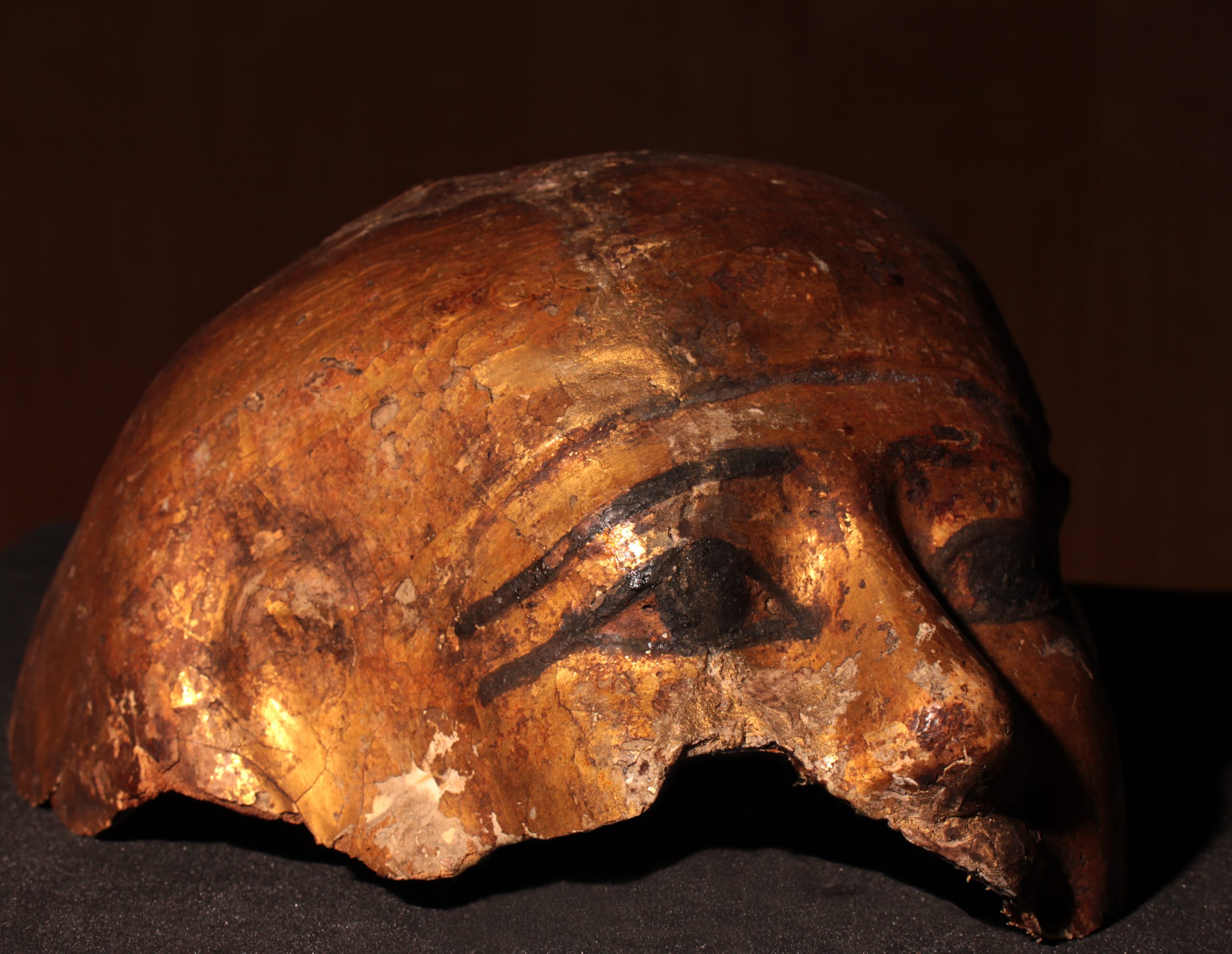
Caption: W919. A cartonnage gilded mask belonging to a women.

 Caption: Kingship case in 'The House of Death' Notice that the accoutrements of kingship on display are associated with male kings, where their names are known.

Fertility and sexuality

Fertility and sexuality are linked together in this section since, as Montserrat (1996) points out, it is very difficult to judge what would have been considered sexual or pornographic in the ancient world. Sexuality is a highly culturally specific definition. It is therefore easier to discuss fertility and sexual occurrences together.

Archaeological excavations at Deir el-Medina have shown that domestic front rooms frequently had depictions of the god Bes painted on walls. As Bes was associated with sexuality, it seems that in New Kingdom Egypt sexuality was not fetishised but was more 'embedded' in social life than in our own society.

Pictures of women in Ancient Egypt seem frequently to show them young and beautiful and wearing see-through outfits. Finds of actual clothing were until recently ignored by excavators, perhaps because they were considered too trivial for serious scholarly study, being more the realm of women, or perhaps because they lacked the glister of amulets and beads for museum displays. 'Many historians do not see textiles as having significance, either to history in general or to the history of art in particular. In works devoted to specific periods of art history, textiles, if discussed at all, are treated as a minor art form lacking the status of architecture, sculpture or painting.' (Carroll 1986).

Those textiles that are now in Egyptological collections show that garments were not see-through but were often bulky and sack like (Hall 1986). The diaphanous net dresses as mentioned in the Westcar Papyrus do seem to exist in a faience form. The Petrie Museum in London has one and other Old Kingdom examples are known. However maybe these were only worn in the grave. Such items are hardly functional. Can you imagine trying to sit down in such a fragile faience dress? Any vigorous dancing or other activities would surely break the beads. We do have some sections of bead netting in the Egypt Centre, but these were perhaps the type of covering placed over mummies in the Third Intermediate Period, associated with both male and female burials.

Caption: W856b. Bead netting probably from a mummy covering

Of course, people may not always have worn the extensive clothing normally considered 'proper' by western society. The lower classes and dancing girls in particular may have been scantily clad or naked (as perhaps were the peasant men in the fields, at least in the Old Kingdom) but, the lack of clothing and the see-through nature of tomb depictions of the upper classes does seem a little exaggerated compared to archaeological examples of clothing. We might also wonder how Egyptian women were able to walk wearing such tight outfits as those shown on tomb walls. They did not have the advantages of lycra and other stretch fabrics available to them. The New Kingdom dresses of the rich were pleated to look tight but allow movement, but it would be unlikely that those of the majority of the population were also of this type.

Caption: W847. A statuette of a man and his wife. Note the tightness of her garment.

This depiction of women as 'sex objects' was probably not simply to amuse men but was associated with birth and fertility. In the tomb this extends to the idea of creation and rebirth in the afterlife. In many reliefs women are shown with their husband holding a lotus, perhaps a symbol of love, and wearing a heavy wig (an erotic symbol) and associated with animals representing sexuality such as the monkey, the duck and the goose.

Caption: W769 Paddle doll. This wooden doll on display in the Egypt Centre may be more a fertility figure than a child's plaything. It has been suggested that the enlarged section at the base represents an emphasised pubic area. However, maybe we should be aware that emphasising female genitalia need not be associated with male titillation but perhaps a female desire for fertility. We need to look at the context in which they are found. Such dolls are after all found in female graves. The shape of the paddle doll is similar to the other female objects such as the 'menit' counterpoise.

However, the representations of sexuality do show that the woman was supposed to make herself attractive to the man and not the other way round. The sexual needs of women in the afterlife seem to have been completely ignored in tomb paintings. Of course, we do not know what Egyptian women considered attractive in their men. 

Caption: Fertility dolls or concubine figurines? In the past clay dolls such as these were described as 'concubine figurines' for the afterlife of dead males. However they are also found in female graves and on settlement sites such as el-Amarna and Piramesse. Like the paddle doll they may well be fertility dolls for women.

Caption: Cowrie shell. Cowrie shell amulets may have been worn as symbols of female genitalia and thus a symbol of sexuality/fertility. They are usually associated with women. This gold example is on loan from Swansea Museum

There are two books on sexuality in ancient Egypt. Manniche (1987) and Montserrat (1996). Of the two, Manniche looks at sexuality from a western perspective whereas Montserrat takes a more reflexive view. 

Caption: W87. Copper alloy cat representing Bastet. Bastet was a goddess of fertility who could take the form of a cat

Caption: W1043- Wooden stela on display made for Pamenes, engendered by Herefernit, born of the Lady of the House Satweret. Very often, the mother of the stela owner is mentioned. It has been suggested that this is because while paternity is debatable there can be no doubt about maternity

Caption: W 765 Swimming girl motif. The motif of the naked adolescent girl is common on tomb chapels, cosmetic pots, mirrors and bowls. In the case of items such as these their shape has solar connections which might provide a link to the goddess Nut. It has been suggested that items such as these are spoons though their function is not entirely certain.

Androgyny

The creator gods of Egypt may be represented as androgynous (Troy 1986, 15-19; Zandee, G. 1992). Usually these are the primeval creator gods, considered to be alone in the beginning and hence without consorts.

Neith

Neith a female goddess is shown as androgynous in that although she lacks a partner she is able to give birth. At Esna she is described as 'the male who acts the role of the female, the female who acts the role of the male.' Unusually for female goddesses, Neith also has warlike characteristics.

Ptah

Although outwardly a masculine deity. Ptah has also been seen as androgynous (Troy 1986, 16-17). He is a god of crafts and as such is concerned with creating.

Atum

Atum, although male, could give birth. Atum the creator god who was alone in the beginning impregnated himself with his own semen and gave birth via his mouth.

Caption: W2051. This is the back segment of a Ptah-Sokar-Osiris figure on which it is written '...hail to thee, heir who proceeded from this god, spittle which came forth from Atum, divine body that returned.'

Amun-Re

Similarly, Amun or Amun-Re is a father who gives birth,

Caption: AB106 Bronze statuette of Amun-Re

Sobek

Sobek, the crocodile god, is also stated to be a primeval god who gave birth to all existence.

Bulti-fish

The bulti-fish, Tilapia nilotica seems to have been a manifestation of the sun-god. The bulti keeps the fertilised eggs in its mouth until they are fry and then spits them out. It therefore appears to be swallowing and then 'giving birth' to them and as such is therefore a symbol of rebirth. Why cosmetic palettes such as this should be in the shape of such a fish is not entirely known. It could be that such palettes were made for rituals such as anointing a statue or may be connected with a funeral. In either case rebirth symbolism would be used. Eyepaints and ointment were essential to resurrection. Before appearing in the 'Hall of Justice' the individual had to purify her/himself, dress in white clothing, make up their eyes and anoint themselves. Applying eyepaint also seems to have been part of everyday cult rituals. Depictions of cows destined for ritual slaughter are sometimes shown wearing eye-paint! There are even depictions of eye make-up being put in the graves of ritually slaughtered bulls.

Further Information On Egypt Centre Fish Palettes

The Solar Disc

The sun is composed of the disk and its rays. The disk is given the masculine designation itn and the rays are personified by the cobra. Cobras are usually identified as female in the Egyptian mythology. In the Amarna period the rays are shown as hands, and the hand functions in myth as the consort of the god.

In the Amarna period a well known hymn to the Aten refers to it as father and mother of his creation.

Sexual Dualism

The idea that it is right and natural that male and female come together seems to be pervasive in ancient Egyptian art. Gods and mortals are frequently mirrored, one male, one female. However, there are exceptions and the it is clear from the Egyptian literature that same-sex desire was known and articulated by the Egyptians.

Archaeologists frequently appear to want to underscore the normative heterosexist narratives of our own culture by forcing it on the past. For example, it is usually assumed that when a woman and man are buried together that some sort if intimacy existed between them. No sort of intimacy is assumed for the frequent burials of same-sex individuals. This is not to say that same-sex burials were those of homosexual individuals but merely to state that we have a tendency to accept that which fits in best with our own cultural views.

Conclusions-The Way Forward?

Most of the discussion above has largely been a critique of androcentric, Eurocentric Egyptology and uses a small collection, the objects in the Egypt Centre, to illustrate the point. To actually construct new theory and to present a feminist Egyptology is much more difficult. Various options are available:

- We might simply use contextual approaches taking archaeology as well as inscriptions and historical evidence to look for women in the past. Of course, there is a need to understand the historiography of all types of evidence before making any use of them. This approach has been successfully achieved by Egyptologists such as Gay Robins (1993). This is perhaps by far the most balanced interpretation of women in ancient Egypt.

- We might also use contemporary social theory to look at the data available. Egyptology has largely lacked theoretical approaches for social archaeology (Janssen 1975, 128), instead falling back on the historical narrative approach. However, there are some exceptions, for example, Dominic Montserrat who uses Foucault to examine gender in Graeco-Roman Egypt (1996). Adopting theories from other disciplines has been criticised in archaeology. Prehistory in particular has recently witnessed a rash of largely untestable ideas taken from various 20th century continental philosophers interpolated upon its data. But at least such methods consciously frame the subject area, unlike the usual uncritical application of our own culture based, unconscious bias to the past.

- We might examine new areas of data, such as has been achieved by Lyn Meskell on her work on the body in ancient Egypt (various articles). The objects themselves are not new but the use of them is.

Further Reading

Introductory Books On Women In Ancient Egypt

Two volumes in particular are useful. The Lynn Meskell volume however does not concentrate purely on women’s studies.

Meskell, Lynn. 1999. Archaeologies of Social Life. Age, Class ‘et cetera’ in Ancient Egypt. Oxford: Blackwell.

Robins, Gay. 1993. Women in Ancient Egypt. London: British Museum Press.

Other volumes include:

Arnold, Dorothea. 1996. The Royal Women of Amarna. New York: The Metropolitan Museum of Art.

Pomeroy, Sarah B. 1984. Women in Hellenistic Egypt. From Alexander to Cleopatra. New York: Schocken Books.

Roberts, Alison, 1995. Hathor Raising: The Serpent Power of Ancient Egypt. Totnes: Northgate.

Troy, Lana. 1986. Patterns Of Queenship In Ancient Egypt Myth and History. Uppsala: University of Uppsala.

Tyldesley, Joyce. 1994. Daughters of Isis Women of Ancient Egypt. London: Penguin.

Tyldesley, Joyce. 1996. Hatchepsut The Female Pharaoh. London: Viking.

Watterson, Barbara 1991. Women in Ancient Egypt. Stroud.


General Books On Gender Studies in Archaeology

Gero, J.M. and M.W. Conkey, eds. 1991. Engendering Archaeology: Women and Prehistory. Oxford: Blackwell

Gilchrist, Roberta. 1999. Gender and Archaeology. London: Routledge.

Nelson, Sarah Milledge. 1997. Gender in Archaeology. Analyzing Power and Prestige. Walnut Creek: Altimira Press.

Select Bibliography

Andrén, A. 1995. Between Artifacts and Texts: Historical Archaeology in Global Perspective. New York: Plenum Press.

Andrews, C. 1990. Ancient Egyptian Jewellery. British Museum Press.

Andrews, C. 1994. Amulets of Ancient Egypt. British Museum Press.

Arnold, Dorothea.1996. The Royal Women of Amarna. New York: The Metropolitan Museum of Art.

Boserup, Ester. 1970. Women's Role in Economic Development, pp 32-33. New York: St Martin’s Press.

Brumfield, Elizabeth, M. 1991. Weaving and Cooking: Women's Production in Aztec Mexico. In Gero and Conkey, eds., Engendering Archaeology Women and Prehistory. 224-251.

Burnstein, Stanley, M. 1985. The Hellenistic Age from the battle of Ipsos to the death of Kleopatra VII.

Capel, A.K. and G.E. Markoe, eds., 1996. Mistress of the House Mistress of Heaven. Women n Ancient Egypt. New York:Hudson Hills Press.

Carroll, D. L., 1986. Looms and Textiles of the Copts. University of Washington Press

Dark, K.R. 1995. Theoretical Archaeology. London: Duckworth.

De Beauvoir, Simone. 1953. The Second Sex. H.M. Parshley, trans. New York: Knopf.

Eilberg-Schwatz, H. and W. Doniger, eds. 1995. Off with her Head: the Denial of Women’s Identity in Myth, Religion and Culture. Berkley: University of California Press.

Engelstad, Erika. 1991. Images of power and contradiction: feminist theory and post-processual archaeology. Antiquity 65: 502–14.

Fischer, H.G. 1976. Varia. New York: Metropolitan Museum of Art

Fransden, P.J., 1992. The letter to Ikhtay's Coffin'. In R. Demarée, Village Voices. 31-49,

Gardiner, Sir Alan. 1961. Egypt of the Pharaohs. Oxford: Oxford University Press.

Gilligan, Carol. 1982. In a Different Voice. Cambridge, Mass.:Havard University Press.

Gero, Joan M. 1992. Genderlithics: Women’s Roles in Stone Tool Production. In J. M. Gero, and Margaret W. Conkey. Engendering Archaeology Women and Prehistory. Oxford: Blackwell.

Gilchrist, Roberta. 1991. Women's archaeology? Political feminism, gender theory and historical revision. Antiquity 65 : 495–501

Gilchrist, Roberta. 1999. Gender and Archaeology. London: Routledge.

Hall, Rosalind. 1986. Egyptian Textiles. Shire Publications.

Hodder, I., 1995. Theory and Practice in Archaeology. London and New York: Routledge.

Janssen, J. 1975. Prologomena to the study of Egypt’s Economic History during the New Kingdom. Studien zur Altägyptishe Kultur 3 : 127-85

Kemp, B.J. 1977. The early development of towns in Egypt: Antiquity 51: 185-200.

Leacock, E.B. 1978. Women’s Status in Egalitarian Societies: Implications for Social Evolution. Cultural Anthropology 19(2):247-275.

Leacock, E. and J. Nash. 1981. Myths of Male Dominance. New York: Monthly Review Press.

Lesko. B., 1989 ed., Women's earliest records from ancient Egypt and Western Asia: Atlanta

Lesko, L.H., 1994. Pharaoh’s Workers. The Villagers of Deir el Medinah. New York: Cornell University Press.

Manniche, L. 1987. Sexual Life In Ancient Egypt. London and New York: Kegan Paul.

Martin, Geoffrey, T. 1974. The Royal Tombs at el-'Amarna, I. London

Meskell, L.M., 1997. Engendering Egypt: a review article. Gender and History: a review article, Body and Gender in the Ancient Mediterranean 9(3): 597-602.

Meskell, L.M. 1997. Egyptian Social Dynamics: The Evidence of Age, Sex and Class in Domestic and Mortuary Contexts. PhD thesis Archaeology Department, Cambridge.

Meskell, Lynn. 1999. Archaeologies of Social Life. Age, Class ‘et cetera’ in Ancient Egypt.

Montserrat, Dominic, 1996. Sex and Society in Graeco-Roman Egypt. London: Kegan Paul International.

Nelson, Sarah Milledge, 1997. Gender in Archaeology. Analyzing Power and Prestige. Walnut Greek: Altamira Press.

Oakley, A., 1974. Women’s Work: The Housewife, Past and Present. New York: Vintage Books.

Pomeroy, Sarah B., 1984. Women in Hellenistic Egypt. From Alexander to Cleopatra.New York: Schocken Books.

Roberts, Alison, 1995. Hathor Raising: The Serpent Power of Ancient Egypt. Totnes: Northgate.

Robins, Gay. 1983. A critical examination of the theory that the right to the throne of Egypt passed through the female line in the 18th dynasty. Göttinger Miszellen, 62: 67-77.

Robins, Gay. 1993. Women in Ancient Egypt. London: British Museum Press.

Rogers, S.C. 1978. Woman’s Place: A Critical Review of Anthropological Theory. Comparative Studies In Society and History. 20(1)

Silverblatt, Irene. 1988. Women in States. Annual Review of Anthropology 17: 427-60.

Stacey, J. and Thorne, B. 1985. The missing feminist revolution in sociology. Social Problems. 32: 301-316.

Toivari, J. 1998. Marriage at Deir el Medinah. In C.J. Eyre, ed., Proceedings of the Seventh International Congress of Egyptologists.

Tronick, E.Z., G.A. Morelli and S. Winn. 1987. Multiple caretaking of Efe (Pygmy) infants. American Anthropology. 89: 96-106.

Troy, Lana. 1986. Patterns Of Queenship In Ancient Egypt Myth and History. Uppsala.

Tyldesley, Joyce. 1994. Daughters of Isis Women of Ancient Egypt. London and New York: Penguin

Tyldesley, Joyce. 1996. Hatchepsut The Female Pharaoh. London: Viking.

Tyldesley, Joyce. 1998. Nefertiti. London: Viking.

Watterson, B. 1991. Women in Ancient Egypt. Stroud: Alan Sutton Publishing.

Wright, Rita P. 1991. Women’s Labor and Pottery Production in prehistory. In Joan M. Gero and Margaret W. Conkey, Engendering Archaeology Women and Prehistory. Oxford: Blackwell, 194-224.

Wylie, A. 1991. Gender theory and the archaeological record: why there is no archaeology of gender? In J.M. Gero and M.W. Conkey, eds., Engendering Archaeology: Women and Prehistory. Oxford: Blackwell, 31-34.

Zandee, J. 1992. The Birth-giving Creator God In Ancient Egypt. In A.B. Lloyd, ed., Studies In Pharaonic Religion and Society. 169-185. London: Egypt Exploration Society, 169-185.

Back To Home Page