PRIFYSGOL ABERTAWE,
SWANSEA UNIVERSITY.
Home | Search | Maps | Graphics.
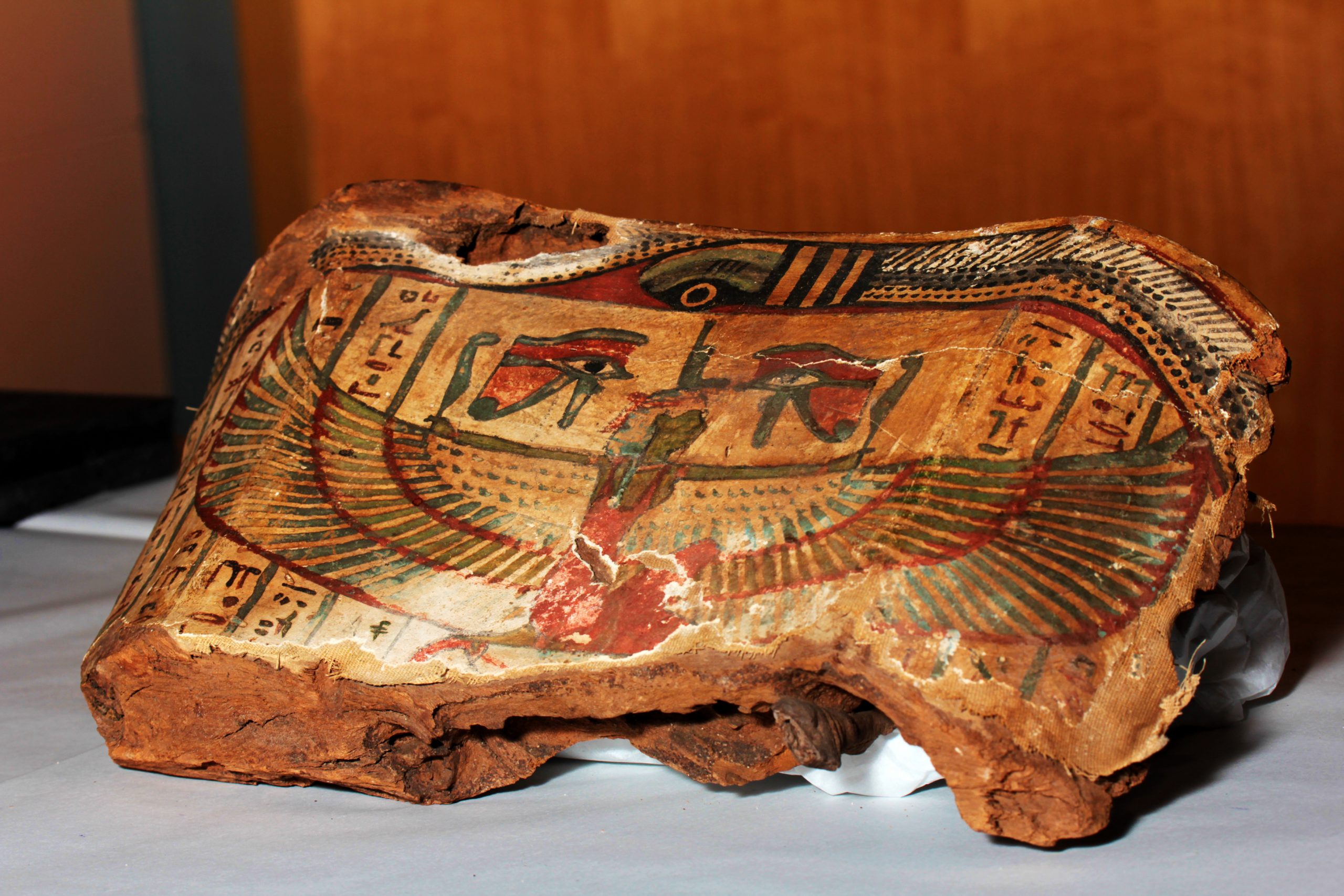
Sycamore Tree Goddess EC490

This piece of cartonnage shows a tree goddess. Such depictions were common from the New Kingdom, the first example being in the tomb of Tuthmosis III. You can see another scene of a tree goddess on the 21st Dynasty coffin on display in The House of Death. The tree was usually the sycamore fig (though the word for sycamore, nht, was used as the general word for 'tree'). The tree was also a trysting place – even today Egyptian women with marital problems linger under the sycamore (Brewer et al. 1994, 146).
Often the goddess is showing pouring out refreshing liquid into the hands of the deceased while their ba (in the form of a bird with human head) stands close by or flutters in the branches.
Hathor and Nut are often depicted as sycamores, Nut being the most common.Hathor is the tree goddess of Memphis and is often known as 'Lady of the sycamore'. According to a New Kingdom story, as 'Lady of the sycamore', she heals the eye of Horus with milk from a gazelle. The juice from the fruit and leaves was milky white and was known by the Egyptians as 'milk of the sycamore'. It was used to heal wounds and abscesses.
Nut the sky goddess could also be shown as a tree goddess in the literature:
I am Nut, I have come to thee bringing thee gifts. Thou sittest under me and coolest thyself under me and coolest thyself under my branches. I allow thee to imbibe of my milk and to live and to have nourishment of my two breasts; for joy and health are in them...Thy mother provides thee with life. She sets thee within her womb wherein she conceives....
From the tomb of Kenamun quoted from Alix Wilkinson The Garden In Ancient Egypt
Some representations show the tree in skeletal form from which the goddess raises. There was a long Memphite tradition of a bare sycamore tree in contrast to the fruit bearing tree. The Pyramid Texts describe a tree which shelters the deities with ‘branches dried up, its interior burnt’ PT1485. Examples are discussed in O Keel (1992, 86-97).
The tree goddess spell occurs in Chapter 59 of the Book of the Dead associated with the goddess Nut. Book of Dead Chapters 109 and 149 describe twin 'sycamores of turquoise' which stood at the eastern gate of heaven from which Re emerged every day. Sometimes such trees appear on New Kingdom tomb paintings with a young bull or calf emerging from them symbolising Re. While the cosmic tree could be Re Horakhty, the sycamore was usually, Nut, Isis or more usually Hathor. Sycamore leaves were also used as funerary amulets.
The sycamore fig is sometimes called the Egyptian mulberry but is not the same plant as the North American or European mulberry. The sycamore fig is a taller tree than the true fig but produces smaller fruits. It has pear shaped leaves.
The cultivation of the sycamore fig is almost exclusive to Egypt where it seems to have been first domesticated. It cannot produce spontaneously due to lack of the correct species of bee to fertilise it. In the south the tree grows wild thanks to the existence of the bee. Cultivated sycamore figs go back to the Neolithic with sycamore represented on tomb walls and on reliefs. The young fruit must be gashed to induce ripening.
Further Reading
Billing, N. 2002. Nut The goddess of life. in text and iconography. Uppsala.
Billing, N. 2004. Writing an Image-The Formulation of the Tree Goddess Motif in the Book of the Dead, Ch. 59. Studien zur Altägyptischen Kultur, 32, 35-50.
Brewer, D.J. and Redford, D.B. and Redford, S. 1994. Domestic Plants and Animals: The Egyptian Origins. Warminster.
Buhl, M.L. ‘The Goddesses Of The Egyptian Tree Cult’ JNES 6 (1947) 80-97.
O' Keel. 1992. Das Recht der Bilder gesehen zu werden: Drei Fallstudien zur Methode der Interpretation altorientalishcer Bilder. Freiburg and Göttingen.
The University | People | Life | Study | Research | Admissions.