PRIFYSGOL ABERTAWE,
SWANSEA UNIVERSITY.
Home | Search | Maps | Graphics.
Reserve Head W164 (2589-2532
BC)
This
stone object measures around 23cm in height. It has traces of blue paint though
these are probably modern (other items in the collection have similar paint). It
is not part of a sculpture as it is carefully smoothed off on the base. Such
items are known by Egyptologists as ‘reserve heads’.
About
30 reserve heads are known, and all come from private mastaba tombs around
These
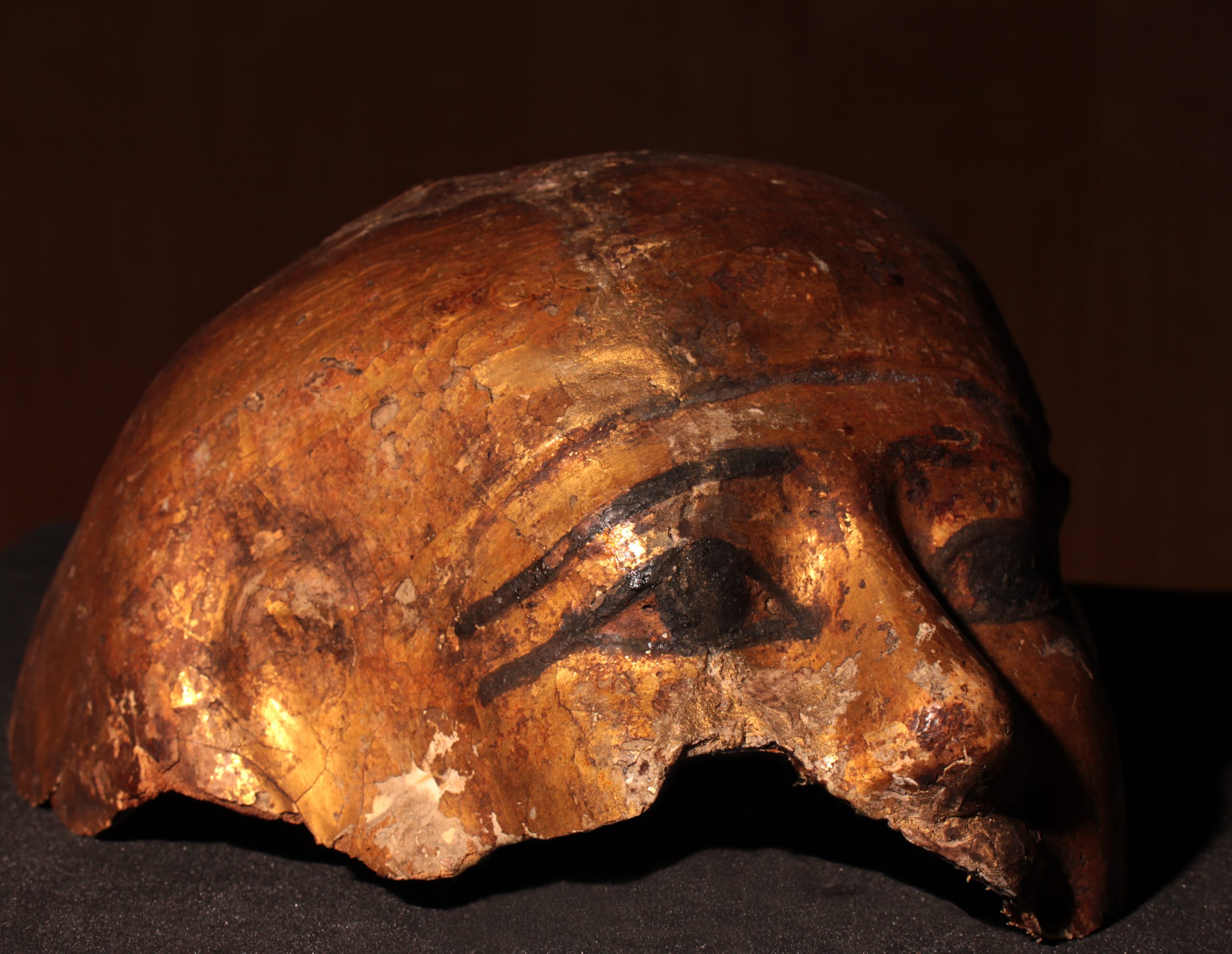
heads are not parts of statues but rather represent complete objects in
themselves. Cropped hair, or a close fitting skull cap, is a feature of these
pieces. A number, like ours (see above, left), have a vertical groove down the
back of the cranium. At least some reserve heads were painted. A black painted
reserve head was found in a burial chamber (Eaton-Krauss 1976, 24) and a head of
Kanofer had traces of black and yellow paint (Knudsen, 1987 quoted in D'Auria et
al., 1988). Red paint was also found on a male reserve head now in the
Their
purpose is uncertain. It is possible that they were intended as an enduring
substitute for the actual head of the deceased, or a means by which the dead
could identify their own body. At this date mummification was not fully
developed and so decay of the body might necessitate a ‘spare’ head.
Many
of the heads have damaged or unfinished ears and incisions cut into their
surface around the neck, as well as, as stated above, down the back of the
cranium. These features have been interpreted as ritual destruction, suggesting
perhaps that the heads symbolised a decapitation and a means of protecting the
living from any evil intentions on the part of the dead. Alternatively, the
intention may have been to protect the dead.
Interestingly,
other structures associated with death and burial were often similarly
dismembered. For example, the southern ships of Khufu, or the canopy found under
Khafre’s satellite pyramid. This canopy had probably been used for
transporting a funerary statue but was then chopped up and put in a blind
passage under the pyramid. In the Pyramid
Texts, hieroglyphs representing human beings are decapitated.
Disassembled
items, including bodies themselves, seem to be a feature of some, but not all,
early burials, from Predynastic times until the end of the
However
it is perhaps dangerous to make too much of this theory in relation to reserve
heads. The destruction of representations of the deceased is not known in other
Egyptian tombs.
One
hypothesis states that reserve heads were sculptor’s prototypes and that
moulds were taken from them, perhaps at the tomb site for workers on relief
portraits or in the sculptor’s workshop (Kelly 1974, 9). This might explain
the scoring around the back of the skull. The sculptor would remove the mask,
once it had dried, by cutting down the skull, leaving a groove. The ears would
often break off in the process. Plaster has been found adhering to one reserved
head (G4940 in
Lacovara (1997) convincingly suggests that the grooves
are actually sculptor’s guidelines used in making the items, and points out
that they are very similar to the hairline marks. In seemingly more finished
examples the marks can hardly be seen or are not presents. The damaged noses and
ears could well be the result of grave-robbers throwing the artefacts aside. The
plaster found adhering to one reserve head may well be the result of the artist
remodelling and incorrectly carved face. Lacovara also suggests that the heads
were used in the same way as the wooden busts of the deceased placed in other
tombs. A large stone sculpture would have been difficult to manoeuvre down a
tomb shaft and so more portable heads were placed there.
Whatever the purpose of the heads, they are for us a
representation of the people of the royal courts of Old Kingdom Egypt, portraits
of the elite. It seems unlikely that these stone artefacts represent the poor.
Unfortunately we know little about the history of our head. It was purchased by Sir Henry Wellcome at a Sotheby auction on 12th-13th November 1928 (item 334).
Further
D'Auria, S., Lacovara, P. Roehrig, C.H., 1988,
Mummies and Magic - The Funerary
Arts of Ancient Egypt
.
Eaton-Krauss, M.., 1984, The Representations of Statuary in Private Tombs of the
Knudsen, J., 1987, ‘A Question of Paint: An
Investigation into Traces of Paint on the Reserve Head from the Tomb of Ka-nofer,’
paper presented at the Annual Meeting of the ARCE, April 24, 1987.
Lacovara, P., 1997, ‘The Riddle of the Reserve
Heads’, KMT 8 (4) 28–36.
Millet, N.B., 1981, ‘The reserve heads of the Old
Kingdom’, In W.K. Simpson and W.M. Davis, eds. Studies in Ancient
Naville, E., 1909, Les têtes de pierre déposées dans les tombeaux égyptiens.
Avec une figure. Mémoire publié
à l'occasion du Jubilé de l'Université. 1559 - 1909.
Smith, W.S., 1949, A History Of Ancient Egyptian Sculpture and Painting In The
Vandersleyen, C.L., 1977, ‘Ersatzkopf’, In W.
Helk, E. Otto and
The University | People | Life | Study | Research | Admissions.