PRIFYSGOL ABERTAWE,
SWANSEA
UNIVERSITY.

Home | Search | Maps | Graphics.

W1912 Weighing Of The Heart Scene

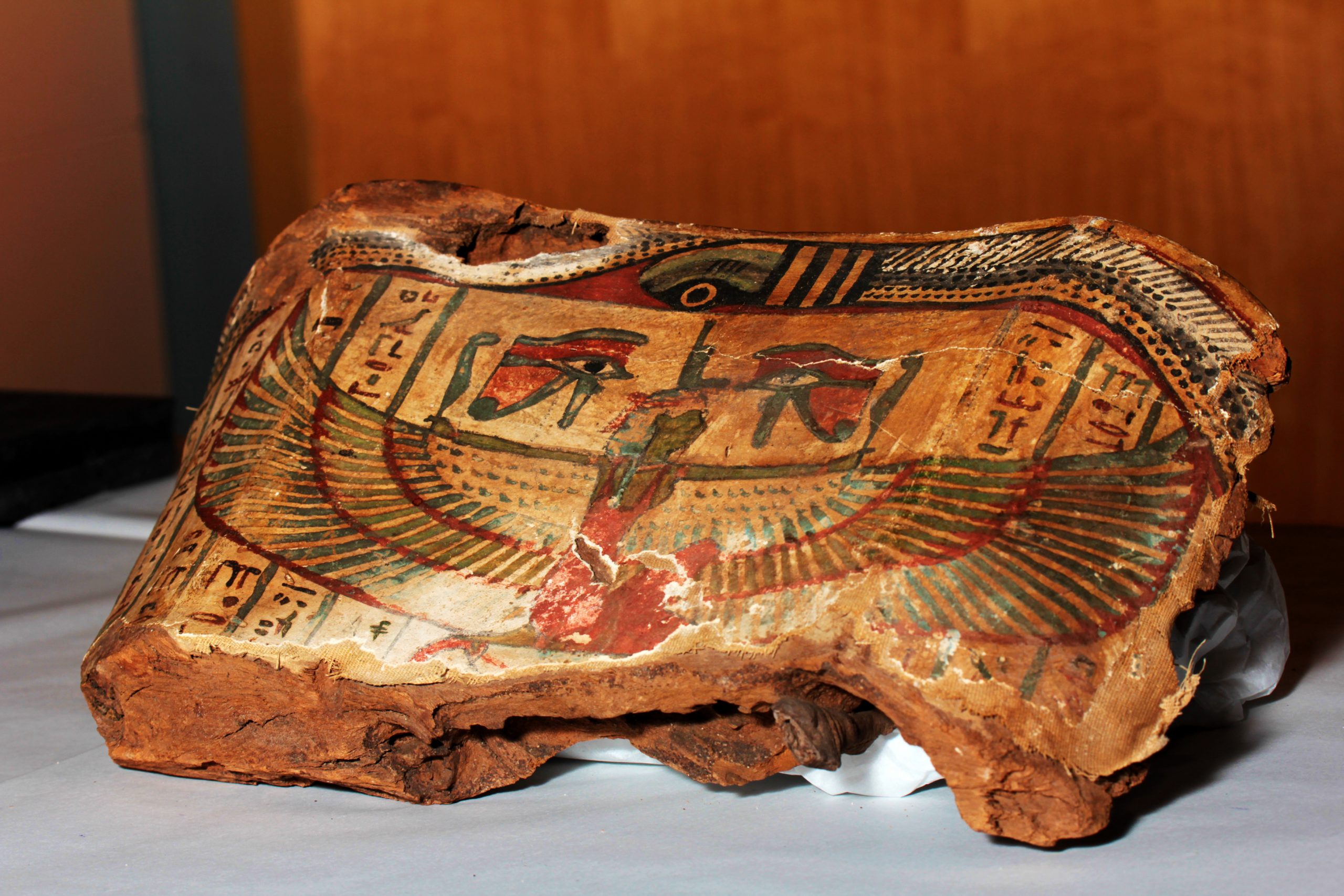
This is a scene from the 21st Dynasty coffin of the lady musician which is on display in the downstairs gallery of the Egypt Centre. The vignette shows the deceased judged and their heart weighed against the 'Maat'  feather, the Feather of Truth. If the heart was heavy and the deceased not judged 'True of Voice' the heart would be eaten by the Devourer

This motif is usually used to illustrate Spell 125 as well as Spell 30B of the Book of the Dead and appears on coffins, papyri and tomb walls. The Egypt Centre also has a shroud depicting the same scene. The theme of the weighing of the heart occurs as early as the 11th Dynasty (Seeber 1976, 67) but scenes are more common in the New Kingdom in tombs and on coffins. The Book of the Dead spells do not mention the weighing of the heart as such.

Here you can see the dog or jackal headed god Anubis standing in front of the scales. Under Anubis’ raised arm are two small figures. The higher one has a lotus blossom in its hair and probably represents the dead person about to be reborn. Underneath the figure is Maat with a feather on her head. She sits on a rectangular block which is the personified birth brick, Meskhenet. In ancient Egypt it seems women squatted on a birthing brick in order to give birth. Only one archaeological example of these has been found, from Abydos. However they are shown in iconography. Roth and Roerig (2002) believe the depiction of Maat on the brick may stem from the idea that a person’s life is mapped out on their birth brick which is taken into consideration on the day of judgment. According to the demotic story of Setne II at judgment by Osiris a man’s deeds are judged according to that which was mapped out for him by Thoth. Seeber (1976, 86-8) discusses this and the metamorphosis of the brick into the goddess Maat. Hence Maat sits on our brick.

On top of the scales sits a squatting baboon with moon disc and crescent on his head. In the right balance pan sits Maat, and in the left is the heart of the dead person. Two parallel lines meaning ‘true of voice’ are positioned near Anubis' left foot. The cords of the scales are hung with what resembles a string of  beads. On some representations e.g. the Papyrus of Nany (Foreman and Quirke 1996, 141)  these are actually amuletic djed and tit symbols.

Thoth sits on top of the scales with the moon-disc and crescent emphasising his lunar role. He is here shown in ape form (he appears elsewhere on the coffin with the head of an ibis). His importance in the weighing of the heart scene is shown in texts where he is a judge and the scribe who records the result. His position on top of scales suggests that he is the personification of judgement particularly as Ma’at sometimes occupies this position (Seeber 1976, 68). He is particularly identified as the indicator of balance, the plummet (Manassa 2006, 127).

Anubis with the dog or jackal-head stands in front of the scales. Anubis is sometimes given the title ‘he who is over the scales’ (Seeber 1976, 154) or, as early as the Pyramid Texts (DuQuesne 2005, 465), ‘assessor of hearts’ and ‘overseer of the tribunal’. His role as a judge and his epithet ‘assessor of hearts’ are discussed by Willems (1998). Prior to the 21st Dynasty Thoth or Horus took the role as deity in charge of the weighing proceedings, during the 21st Dynasty, Anubis takes on this role. Two parallel lines meaning ‘true of voice’ are positioned near Anubis left foot. ‘True of voice’ indicates that the deceased has been found suitable to enter the afterlife.

The higher of the two squatting figures, the one with the lotus flower in its hair is shown with crossed arms and the net covering alluding to Osiris. Some depictions are more explicitly Osirian and show the figure holding a crook and flail. Others show this figure as a child (Seeber 1976, 101-104). The lotus flower is additionally a symbol of rebirth. All these symbolic references suggest that the figure represents the deceased waiting to be reborn. On the papyrus of Nany the figure is painted black which suggested to Foreman and Quirke (1996, 141) that this is the deceased’s shadow. The figure is typical of the 21st Dynasty (Seeber 1976, 102).

References

Foreman, W and Quirke, S., 1996. Hieroglyphs and the Afterlife in Ancient Egypt.

Manassa, C. 2006. The Judgement Hall of Osiris in the Book of Gates. Revue d’Égyptologie 57, 109-150.

Roth, A.M. and Roehrig, C.H., 2002. Magical Bricks and the Bricks of Birth. Journal of Egyptian Archaeology 88, 121-139.

Seeber, C., 1976. Untersuchungen zur Darstellung des Totengerichts im Alten Ägypten. Berlin: Deutscher Kunstverlag.

Back to The Collection.

Back to Title Page


The University | People | Life | Study | Research | Admissions.