PRIFYSGOL ABERTAWE,
SWANSEA UNIVERSITY.
Home | Search | Maps | Graphics.
This object was chosen as Egypt
Centre's Object of the month August 2009.

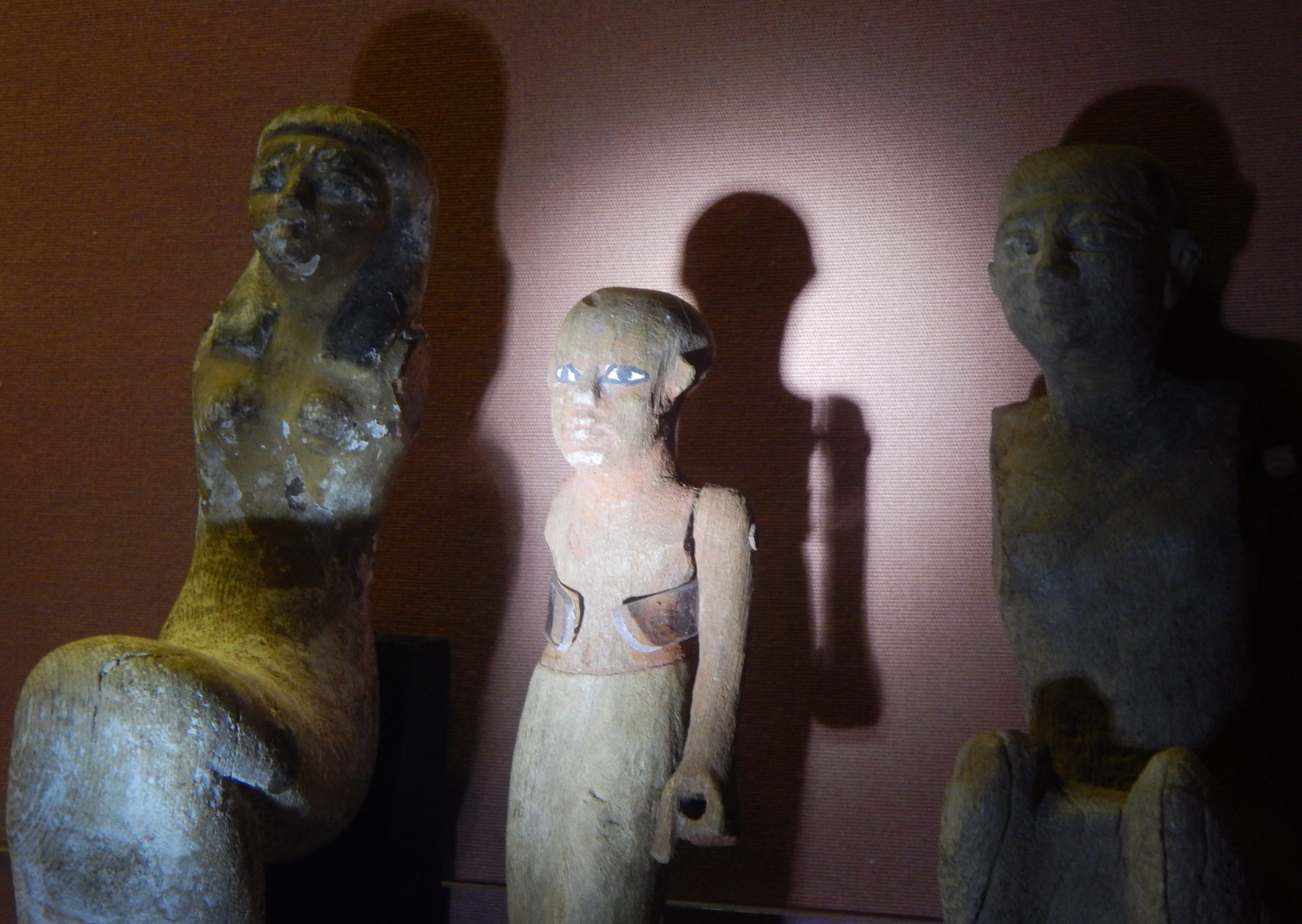
This flat, paddle shaped,
wooden figure was purchased by Sir Henry Wellcome at a Sotheby’s auction in
1919.
Such dolls are usually found
in
The marks on the body are
thought to be tattoos or scarification and the end of the paddle, it has been
suggested, is an exaggerated pubic area. That such dolls are found mainly in
female graves has led Egyptologists to suggest that these are fertility
figurines put in graves to ensure fertility in the afterlife.
Tattoo and scarification
marks have been found on some Egyptian female mummies of the 11th Dynasty. These
tattoo and scarification marks, being abstract dots and lines in geometric
patterns are similar to those shown on the paddle dolls.
There are also later
The shape of their bodies
has been compared to the counterpoise of an Egyptian necklace called a menat.
It has been suggested that both are stylized versions of Hathor's body.
Further
Bourriau, J. 1988, Egyptians and Mortals. Egyptian Art in the Middle
Kingdom.
Capel, A.K. and G.E.Markoe, eds., 1997. Mistress of the House Mistress
of Heaven. Women in Ancient
Hayes, W.C. 1953. The Sceptre of
Keimer, L. 1948. Remarques sur le
Tatouage dans l'Egypte Ancienne.
© Egypt Centre 2009
Back to list of objects of the month
The University | People | Life | Study | Research | Admissions.